
The model behind every report
The Integrated SNP/CHC Model
The Integrated School Neuropsychological/Cattell-Horn-Carroll Model is a way of organizing assessment results by what each test measures, so a report reads as one picture of the person and not a list of tests. PsychWriterPro builds every report around it.
Facilitators / Inhibitors
Cognitive Processes
Acquired Knowledge
Basic Sensorimotor Capabilities
Social-Emotional, Cultural, Environmental Factors
Also reported alongside the model
The idea
How the model works
Four ideas explain how the parts relate to each other.
Cognitive processes drive learning
They influence all aspects of acquired knowledge: what we learn in school and through experience.
Sensorimotor capabilities underlie both
Seeing, hearing and touching influence both cognitive processes and acquired knowledge.
Some processes help or hinder
Attention, working memory, and speed and efficiency can facilitate or inhibit the rest.
Context affects it all
Social-emotional, cultural and environmental factors may affect every part of the model.
Integrated SNP/CHC Model: Miller, 2013; Miller & Maricle, 2019; Miller & Maricle, 2022.
Interactive
Explore the model
Pick a domain to see what its report tables measure and which tests contribute scores. PsychWriterPro has 245 report tables across 17 domains.
Select any part of the model
Facilitators / Inhibitors
Cognitive Processes
Acquired Knowledge
Basic Sensorimotor Capabilities
Social-Emotional, Cultural, Environmental Factors
Also reported alongside the model
Facilitators/Inhibitors
Working Memory
4
report tables
35
tests contribute scores
What gets measured
Working Memory
Measures a student’s ability to actively manipulate information retrieved from memory.
Tables for specific tests
Rating scales, checklists and validity tables that report one test on its own.
- Qualitative Behaviors for Working Memory
- Working Memory (NPCC-3)
- Working Memory Facilitators (NPCC-4)
Tests that contribute
In practice
What it means for your reports
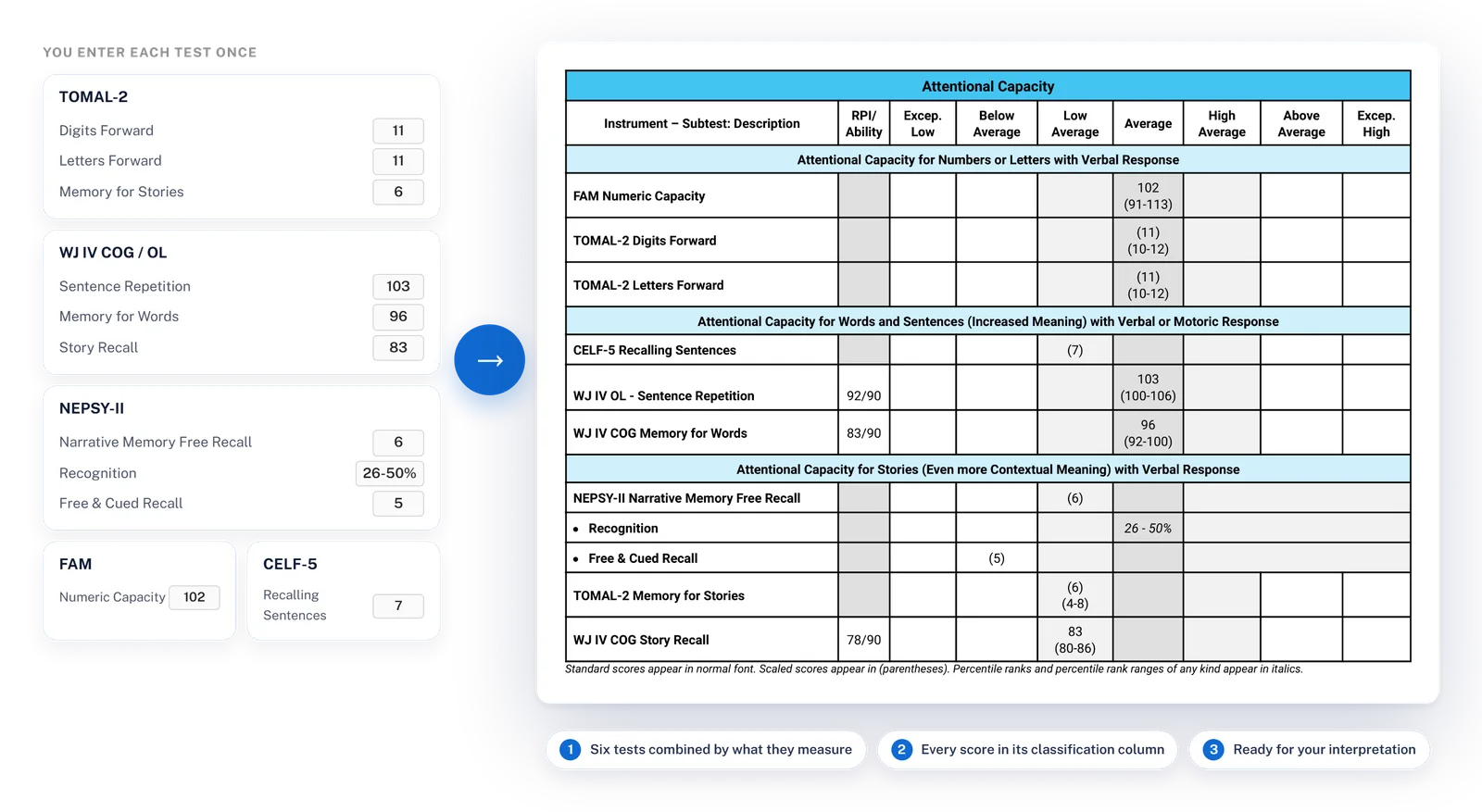
When a report follows the model, scores from different tests sit together by what they measure.
- A working memory table can hold subtests from the WISC-V, WRAML3 and other tests side by side.
- Every score lands in its classification column, so strengths and weaknesses show at a glance.
- Readers see one picture of the person, domain by domain, instead of test by test.
- You choose which domains and tables appear in each report.
Questions
About the model
Who developed it?
The model was developed by Daniel C. Miller, Ph.D. (Miller, 2013; Miller & Maricle, 2019; Miller & Maricle, 2022). Dr. Miller is part of the team behind PsychWriterPro.
How does PsychWriterPro use the model?
Every report is organized by the model. Each score you enter is placed in the report table for what it measures, so subtests from different tests appear together in the same domain. You can turn domains on or off for each report.
Do I have to use the model to use PsychWriterPro?
The report structure follows the model, but you control what appears: you choose which domains and tables to include, and the layout of the report.
See the model in a real report
Try PsychWriterPro free for 14 days, with a sample patient set up for you on day one.