
NPCC-4 report writing, without the busywork
Enter your Neuropsychological Processing Concerns Checklist for School-Aged Children & Youth – Fourth Edition scores once. PsychWriterPro classifies them, builds the score tables and helps you write the interpretation, then exports a finished report to Word or PDF.
14-day free trial · Cancel anytime
Entered for 2,500+ patients by PsychWriterPro customers
NPCC-4
What PsychWriterPro does with NPCC-4 scores
The NPCC-4 includes eight different areas: attention, sensorimotor functions, language functions, memory and language functions, executive functions, cognitive fluency, processing speed, academic functions (reading, writing, and math), and social-emotional functioning.
Every score classified
Each NPCC-4 score gets its classification as you enter it, with no manual lookup.
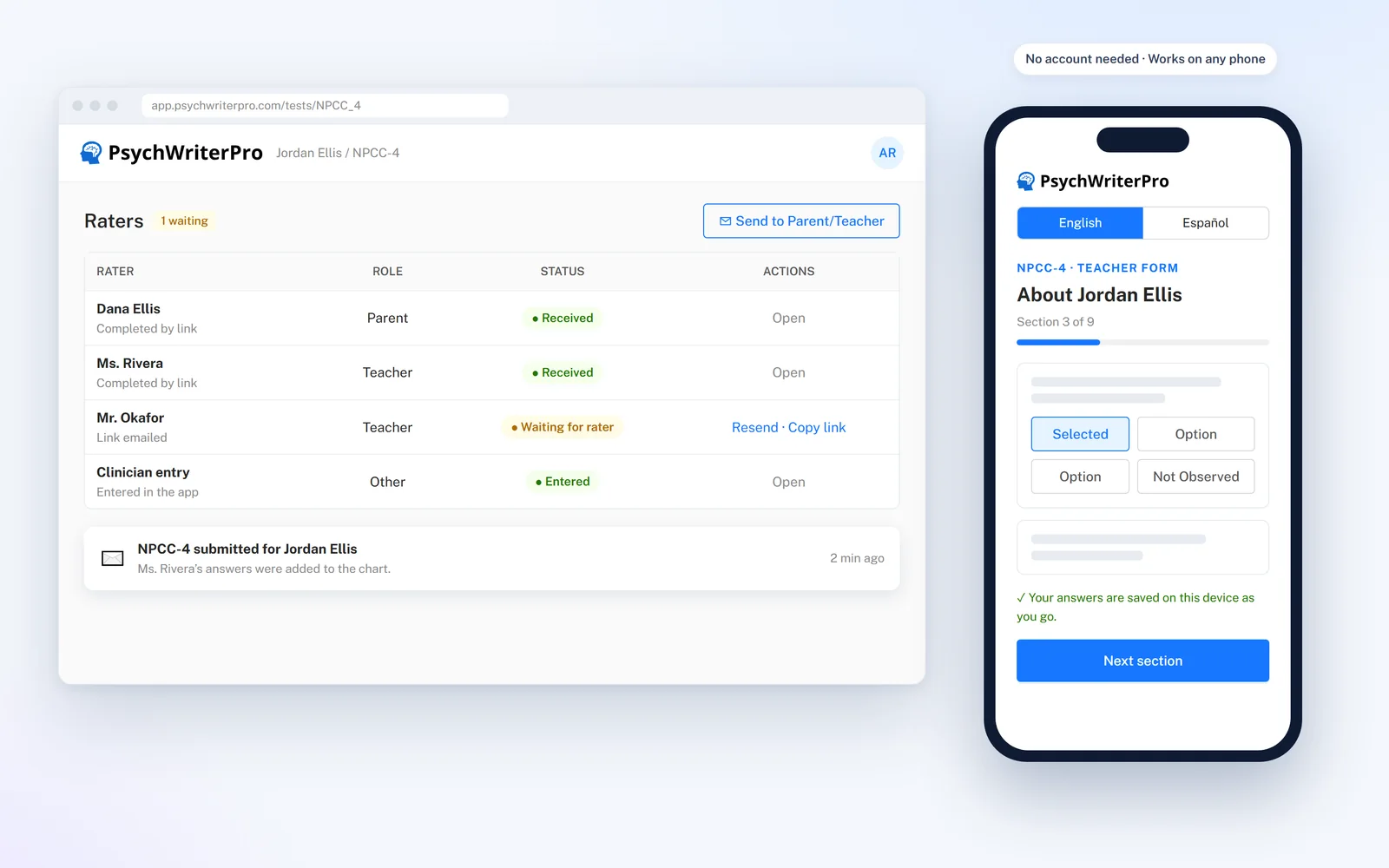
Send the form online
Email a secure NPCC-4 link to a parent or teacher. They fill it in on any phone, in English or Spanish, and their answers go straight into the chart.
Placed in the right domain
NPCC-4 results land in the report tables for what they measure, alongside the other tests you gave.
Report coverage
Where NPCC-4 scores appear in your report
PsychWriterPro places 148 NPCC-4 scores into 14 report tables across 14 clinical domains.
- NPCC-4 scores in report tables
- 148
- report tables
- 14
- clinical domains
- 14
Basic Sensorimotor Functions
1 table · 19 scores
Sensorimotor Functions (NPCC-4)
The Neuropsychological Processing Concerns Checklist for School-Aged Children & Youth – Fourth Edition (NPCC-4) was completed by:
- Difficulty controlling volume when speaking
- Known or suspected hearing problems n/a
- Known or suspected vision problems
- Difficulty identifying smells or tastes
- Less sensitive to pain and changes in temperature
- Complains of numbness in a body part
- Seems unaware of personal physical space relative to others or objects
- Muscle weakness or paralysis
- Muscle tightness or spasticity
- Clumsy or awkward body movements
- Difficulty with walking, running, posture, or balance
- Difficulties holding or manipulating objects (e.g., pencils, buttons, zippers)
- Difficulties with drawing or copying
- Difficulties with eye-hand coordination (e.g., catching and throwing)
- Displays odd movements (e.g., hand flapping, toe walking)
- Displays involuntary or repetitive movements
- Ignores one side of the page while drawing or reading
- Overly sensitive to touch, light, pain, or noise (e.g., overreacts)
- Less sensitive to touch, light, pain, or noise
Cognitive Processes: Executive Functions
1 table · 16 scores
Executive Functions (NPCC-4)
The Neuropsychological Processing Concerns Checklist for School-Aged Children & Youth – Fourth Edition (NPCC-4) was completed by:
- Difficulty transitioning from one activity to another
- Difficulty considering new ways of doing things
- Gets stuck on one activity or train of thought
- Makes the same kinds of errors over and over, even after corrections
- Difficulty with making plans
- Difficulty figuring out how to start a complex task
- Difficulty solving problems that a younger person can do n/a
- Difficulty organizing personal belongings and schedules
- Lacks common sense or judgment
- Struggles to get started on tasks (e.g., homework, chores)
- Tendency to act before thinking
- Difficulty waiting their turn
- Tendency to interrupt others
- Demonstrates signs of over activity (hyperactivity)
- Difficulty recovering from setbacks or disappointments
- Quickly becomes frustrated and gives up easily
Acquired Knowledge: Mathematics Achievement
1 table · 15 scores
Acquired Knowledge: Mathematics (NPCC-4)
The Neuropsychological Processing Concerns Checklist for School-Aged Children & Youth – Fourth Edition (NPCC-4) was completed by:
- Forgets the order of steps when solving math problems
- Makes computational errors
- Slow in solving math problems
- Makes careless mistakes while solving math problems
- Does not always pay attention to the mathematical signs in problems
- Difficulty aligning a column of numbers
- Difficulty understanding spatial attributes such as size and location of numbers
- Difficulty recognizing visual differences in magnitude (e.g., which group of objects has more than another group?)
- Difficulty with retrieval of basic math facts
- Difficulty solving story problems
- Difficulty with counting
- Slow in number identification
- Avoids math activities
- Appears anxious/uptight/nervous when working with math
- Show no interest in math
Acquired Knowledge: Written Language Achievement
1 table · 15 scores
Acquired Knowledge: Writing (NPCC-4)
The Neuropsychological Processing Concerns Checklist for School-Aged Children & Youth – Fourth Edition (NPCC-4) was completed by:
- Demonstrates uneven spacing between words and letters
- Trouble staying on the horizontal lines when writing
- Trouble forming letters and words (e.g., messy handwriting)
- Handwriting is especially small or large
- Limited vocabulary for age; uses lots of easy words when writing
- Difficulty putting ideas into words
- Uses simple sentence structure and lacks variety
- Poor spelling when writing
- Poor grammar when writing
- Difficulty holding the pencil or pen correctly
- Presses too soft with the pencil/pen while writing
- Presses too hard with the pencil/pen while writing
- Avoids writing activities
- Appears anxious/uptight/nervous while writing
- Shows no interest in writing activities
Facilitators/Inhibitors: Speed, Fluency, and Efficiency of Processing
1 table · 15 scores
Speed, Fluency, and Efficiency of Cognitive Processing Facilitators (NPCC-4)
The Neuropsychological Processing Concerns Checklist for School-Aged Children & Youth – Fourth Edition (NPCC-4) was completed by:
- Takes longer to complete tasks than others the same age
- Homework takes too long to complete
- Requires extra time to complete tests
- Responds slowly when asked questions
- Does not do well on timed tests
- Difficulty recalling information accurately and quickly
- Tendency to complete work quickly but not accurately
- Difficulty reading quickly and accurately
- Slow and deliberate reader
- Difficulty reading aloud smoothly
- Takes a long time to write even simple sentences
- Takes additional time to copy notes
- Has difficulties generating ideas for writing
- Takes a long time to solve math problems
- Difficulty pulling basic math facts out of memory quickly
Acquired Knowledge: Reading Achievement
1 table · 11 scores
Acquired Knowledge: Reading (NPCC-4)
The Neuropsychological Processing Concerns Checklist for School-Aged Children & Youth – Fourth Edition (NPCC-4) was completed by:
- Over relies on sounding out most words when reading, even familiar words
- Over relies on memorizing what words look like rather than sounding them out
- Substitutes words that sound like the target word (e.g., reading “pear” for “bear”)
- Substitutes words that mean the same as the word being read, but not the word itself (e.g., reading “truck” for “car”)
- Has a limited reading vocabulary
- Difficulty understanding what is read
- Difficulty identifying main elements of a story
- Misses important details while reading
- Avoids reading activities
- Appears anxious/uptight/nervous while reading
- Shows no interest in reading for information or pleasure
Acquired Knowledge: Language Abilities
1 table · 8 scores
Acquired Knowledge: Language Abilities (NPCC-4)
The Neuropsychological Processing Concerns Checklist for School-Aged Children & Youth – Fourth Edition (NPCC-4) was completed by:
- Slow labored speech
- Limited vocabulary when speaking
- Makes odd or unusual language or vocal sounds
- Distorts sounds (e.g., slurring, stuttering)
- Difficulty finding the right word to say
- Trouble understanding what others are saying
- Does not do well with verbal directions
- Does not follow conversations well
Cognitive Processes: Learning and Memory
1 table · 7 scores
Learning and Memory Processes (NPCC-4)
The Neuropsychological Processing Concerns Checklist for School-Aged Children & Youth – Fourth Edition (NPCC-4) was completed by:
- Difficulty remembering verbal information (e.g., stories, instructions)
- Difficulty remembering visual information (e.g., shapes, faces)
- Forgets where they left personal items or schoolwork
- Forgets to turn in homework
- Cannot remember what happened days or weeks ago (e.g., conversations or events)
- Does well on daily assignments but does not remember the information later
- Limited knowledge of basic facts for places, events, and people
Facilitators/Inhibitors: Allocating and Maintaining Attention
1 table · 6 scores
Attentional Facilitators (NPCC-4)
The Neuropsychological Processing Concerns Checklist for School-Aged Children & Youth – Fourth Edition (NPCC-4) was completed by:
- Difficulty paying attention for a long period of time
- Seems to lose place in an academic task (e.g., reading, writing, math)
- Mind appears to go blank or loses train of thought
- Inattentive to details or makes careless mistakes
- Frequently asks for repetitions of instructions/explanations
- Misplaces possessions
Facilitators/Inhibitors: Working Memory
1 table · 5 scores
Working Memory Facilitators (NPCC-4)
The Neuropsychological Processing Concerns Checklist for School-Aged Children & Youth – Fourth Edition (NPCC-4) was completed by:
- Trouble performing multiple step procedures (e.g., in mathematics)
- Loses track of steps when completing a task
- Trouble summarizing narrative or text material
- Difficulty thinking about sequencing steps to accomplish a task
- Loses train of thought while writing
Cognitive Processes: Auditory/Phonological
1 table · 4 scores
Auditory Processes (NPCC-4)
The Neuropsychological Processing Concerns Checklist for School-Aged Children & Youth – Fourth Edition (NPCC-4) was completed by:
- Difficulty discriminating sounds (e.g., /d/ vs. /b/ sounds)
- Difficulty blending sounds to form words
- Difficulty rhyming
- Omits or substitutes sounds when reading or speaking
Acquired Knowledge: Acculturation Knowledge
1 table · 3 scores
Acquired Knowledge: Acculturation Knowledge (NPCC-4)
The Neuropsychological Processing Concerns Checklist for School-Aged Children & Youth – Fourth Edition (NPCC-4) was completed by:
- Lacks knowledge of everyday facts about the world.
- Difficulty answering common sense “what,” “where,” and “how” questions.
- Lacks general knowledge about science, social studies, and humanities (e.g., the arts).
Cognitive Processes: Visuospatial
1 table · 3 scores
Visuospatial Processes (NPCC-4)
The Neuropsychological Processing Concerns Checklist for School-Aged Children & Youth – Fourth Edition (NPCC-4) was completed by:
- Poor sense of direction (e.g., gets lost easily)
- Right-left confusion
- Difficulties putting puzzles together
Included
Everything you need to write up the NPCC-4
Scores validated as you enter them
Classifications filled in automatically
Ready-made score tables, organized by clinical domain
A Word-style editor under every table for your interpretation
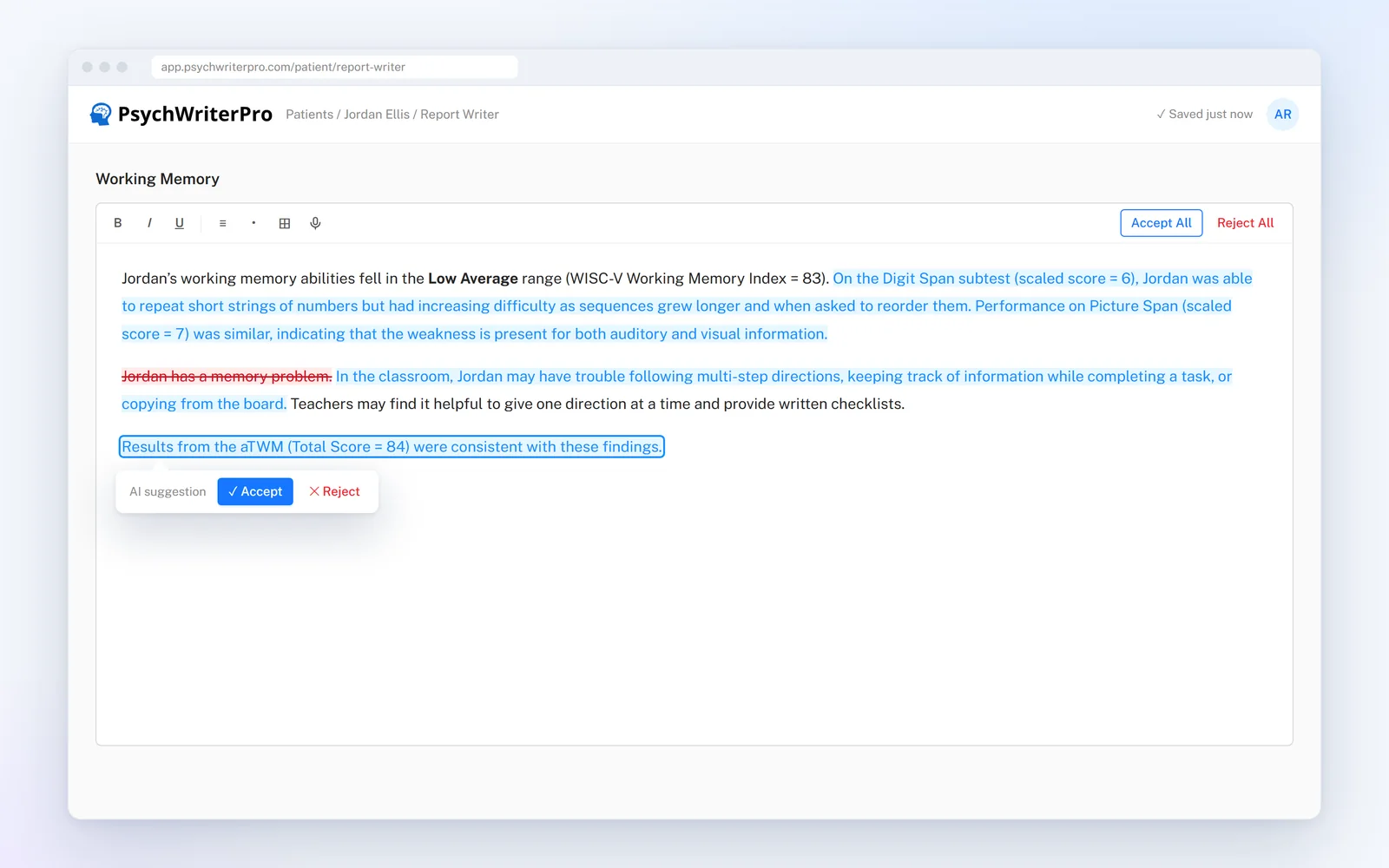
AI drafting from the scores, as tracked changes you accept or reject
One-click export to Word or PDF with your branding
Tests often reported with the NPCC-4
All of these are supported, and their scores share the same report tables.
Questions
NPCC-4 and PsychWriterPro
Does PsychWriterPro score the NPCC-4?
No. PsychWriterPro is a report writer, not a scoring service. You enter or import the scores from the publisher's scoring, and PsychWriterPro classifies them, lays out the tables and helps you write the report.
Can I combine the NPCC-4 with other tests in one report?
Yes. Reports are organized by clinical domain, so NPCC-4 subtests appear alongside subtests from the other tests you gave, in the table for what they measure. 297+ tests are supported.
What does a NPCC-4 report look like?
You choose the layout: a full report, tables only, narratives only, or narratives with the tables in an appendix. Reports export to Word or PDF with your letterhead and colors. Sample reports are on the Sample Reports page.
Can I try it first?
Yes. There is a 14-day free trial, and a sample patient is set up for you on day one.
Write your next NPCC-4 report in PsychWriterPro
Try it free for 14 days, with a sample patient set up for you on day one.
NPCC-4 is a trademark of its publisher, KIDS, Inc.. PsychWriterPro is an independent product and is not affiliated with or endorsed by KIDS, Inc..