
WISC-V report writing, without the busywork
Enter your Wechsler Intelligence Scale for Children, Fifth Edition scores once. PsychWriterPro classifies them, builds the score tables and helps you write the interpretation, then exports a finished report to Word or PDF.
14-day free trial · Cancel anytime
Entered for 5,000+ patients by PsychWriterPro customers
WISC-V
What PsychWriterPro does with WISC-V scores
Assesses cognitive ability and problem-solving processes of children aged 6 to 16:11 years.
Every score classified
Each WISC-V score gets its classification as you enter it, with no manual lookup.
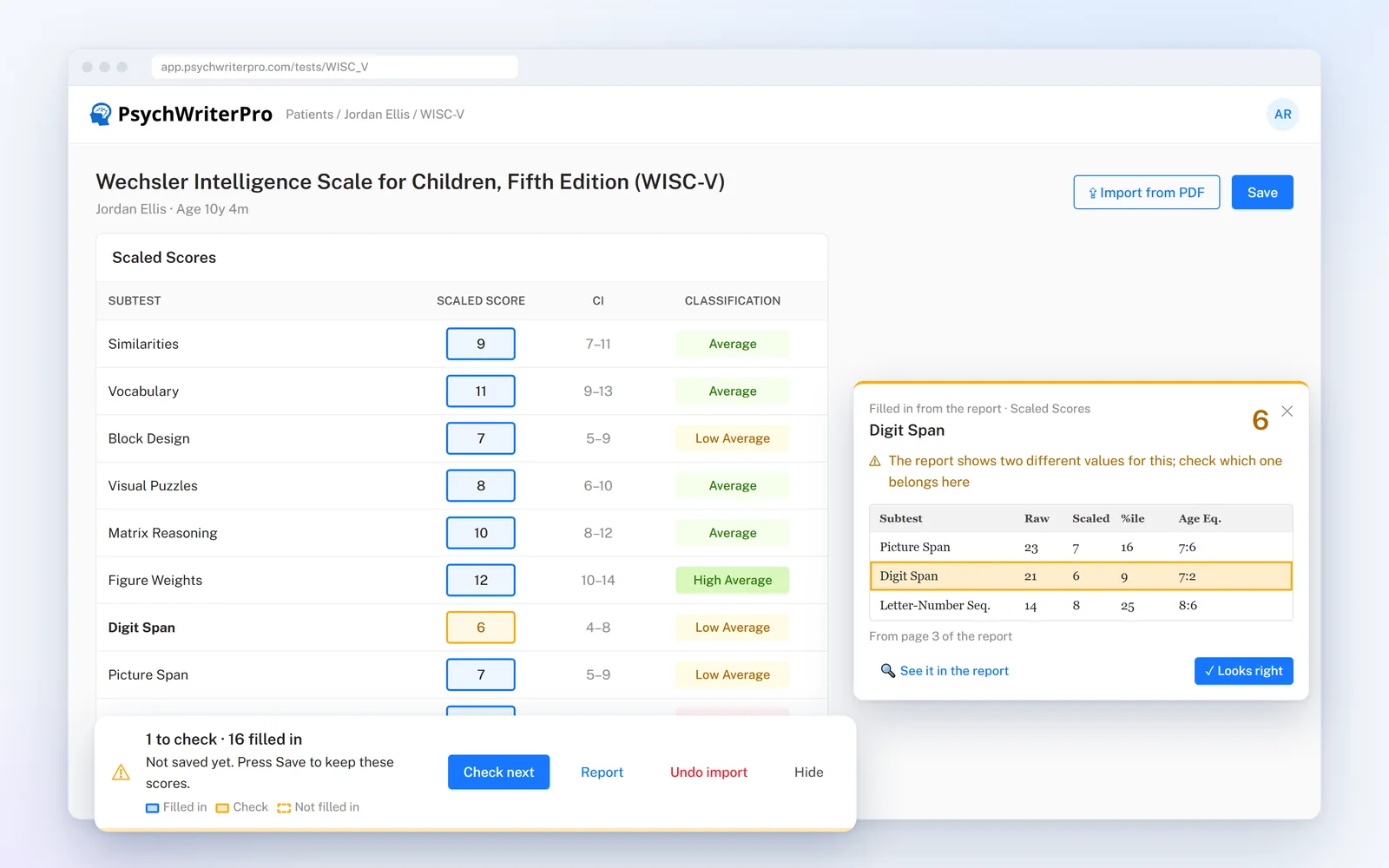
Import from the score report
Drop in the publisher's WISC-V score report and the scaled scores fill in, with each value shown next to the line it came from.
Placed in the right domain
WISC-V results land in the report tables for what they measure, alongside the other tests you gave.
Report coverage
Where WISC-V scores appear in your report
PsychWriterPro places 86 WISC-V scores into 17 report tables across 10 clinical domains, with confidence intervals where they apply.
- WISC-V scores in report tables
- 86
- report tables
- 17
- clinical domains
- 10
Facilitators/Inhibitors: Speed, Fluency, and Efficiency of Processing
2 tables · 21 scores
Qualitative Behaviors for Processing Speed and Fluency
- WISC-V Cancellation Random – Structured Comparison Percentage of same age peers with a difference between marking target objects in a random versus structured arrays.
- WISC-V Coding Rotation Errors Percentage of same age peers who made this number of rotation errors on the Coding test.
- WISC-V Symbol Search Set Errors Percentage of same age peers who made set errors on Symbol Search.
- WISC-V Symbol Search Rotation Errors Percentage of same age peers who made rotation errors on Symbol Search.
- WISC-V Naming Speed Literacy Errors Percentage of same age peers who made literacy errors on Naming Speed.
- WISC-V Naming Speed Color-Object Errors Percentage of same age peers who made errors naming objects and colors quickly.
- WISC-V Naming Speed Size-Color-Object Errors Percentage of same age peers who made errors naming sizes, objects, and colors quickly.
- WISC-V Naming Speed Letter-Number Errors Percentage of same age peers who made errors naming numbers and letters quickly.
- WISC-V Naming Speed Quantity Errors Percentage of same age peers who made quality errors naming numbers and letters quickly.
- WISC-V Naming Speed Color-Object – Naming Speed Size-Color-Object Percentage of age peers with differences between two types errors when quickly naming colors and objects versus sizes, objects, and colors.
- WISC-V Naming Speed Size-Color-Object – Naming Speed Letter-Number Percentage of age peers with differences between two types errors when quickly naming sizes, objects, and colors versus naming letters and number.
Performance Fluency
Measures the student’s ability to quickly perform simple repetitive tasks.
- WISC-V Cancellation Marking target pictures within a visual set of pictures in a specified time period.
- Cancellation Random Marking target pictures within a random visual set of pictures in a specified time period.
- Cancellation Structured Marking target pictures within a structured visual set of pictures in a specified time period.
- WISC-V Coding Copying symbols paired with geometric shapes or numbers within a time limit.
- WISC-V Symbol Search Scanning a search group and marking the presence or absence of a target symbol or symbols within a time limit.
- WISC-V Naming Speed Literacy Correctly identified letters, numbers, and colors as rapidly as possible.
- WISC-V Naming Speed Color-Object Completion time in naming objects and colors quickly.
- WISC-V Naming Speed Size-Color-Object Completion time in naming sizes, objects, and colors quickly.
- WISC-V Naming Speed Letter-Number Completion time in naming numbers and letters quickly.
- WISC-V Naming Speed Quantity Correctly naming the number of various stacks of blocks on a page as rapidly as possible.
Facilitators/Inhibitors: Working Memory
2 tables · 17 scores
Qualitative Behaviors for Working Memory
- Longest Digit Span Backward Percentage of same age peers who achieved this number of the longest digit span backward (auditory working memory).
- Longest Digit Span Sequence Percentage of same age peers who achieved this number of the longest digit span sequence (auditory working memory).
- Longest Picture Span Stimulus The highest number of stimulus pictures that appear on the last item with a perfect score.
- Longest Picture Span Response The highest number of response pictures that appear on the last item with a perfect score.
- Longest Letter-Number Sequence The highest letter-number sequence compared to same age peers.
- Digit Span Forward – Digit Span Backward Percentage of age peers with auditory immediate memory > auditory working memory.
- Digit Span Forward – Digit Span Sequencing Percentage of age peers with auditory immediate memory > auditory working memory.
- Digit Span Backward – Digit Span Sequencing Percentage of age peers with differences between two types of auditory working memory.
- Letter-Number Sequencing – Digit Span Sequencing Percentage of age peers with differences two types of auditory working memory.
- Longest Digit Span Forward – Longest Digit Span Backward Percentage of age peers with auditory immediate memory > auditory working memory.
- Longest Digit Span Forward - Longest Digit Span Sequence Percentage of age peers with auditory immediate memory > auditory working memory.
- Longest Digit Span Backward - Longest Digit Span Sequence Percentage of age peers with differences between two types of auditory working memory.
Working Memory
Measures a student’s ability to actively manipulate information retrieved from memory.
- WISC-V Arithmetic Mentally solving orally presented arithmetic problems within time limits.
- WISC-V Digit Span Backward Repeat number strings in reverse order that were spoken by the examiner.
- WISC-V Digit Span Sequencing Ability to sequence digits according to value. Also involves quantitative reasoning.
- WISC-V Letter-Number Sequencing Recalling numbers in ascending order and letters in alphabetical order.
- WISC-V Picture Span Ability to recall the order of visual stimuli.
Cognitive Processes: Visuospatial
3 tables · 8 scores
Qualitative Behaviors for Visuospatial Processes
- Block Design – Block Design No Time Bonus
- Block Design – Block Design Partial Score
- Block Design Dimension Errors
- Block Design Rotation Errors
Visuospatial Perception
Measures ability to make visual discriminations, locate objects in space, and construct objects.
- WISC-V Block Design Re-creation of a constructed model or a picture of a block design within a specified time limit.
- Block Design No Time Bonus Re-creation of a constructed model or a picture of a block design with no time bonus.
- Block Design Partial Score Partial ability to construct block designs.
Visuospatial Reasoning
Measures ability to recognize spatial configurations, identify objects with missing parts, and match similar visual patterns.
- WISC-V Visual Puzzles Identify two or more pieces that go together to form a complete target shape.
Cognitive Processes: Learning and Memory
3 tables · 7 scores
Verbal-Visual Associative Learning and Recall
Measures ability to learn and remember information that requires both verbal and visual associations.
- WISC-V Storage and Retrieval Index Broad estimate of long-term storage and retrieval accuracy and fluency.
- WISC-V Immediate Symbol Translation Learning visual-verbal associations and then recalling them.
- WISC-V Delayed Symbol Translation Recalling, after a delay, visual-verbal associations.
- WISC-V Recognition Symbol Translation Ability to view a symbol and select the associated word from among response options.
Immediate Verbal Memory
Immediate recall of letters, numbers, words, sentences, and stories quickly after exposure.
- WISC-V Digit Span Repeating auditorily presented digits of increasing length forwards and backwards.
- Digits Forward Repeating auditorily presented digits of increasing length.
Qualitative Behaviors for Immediate Verbal Memory
- WISC-V Longest Digit Span Forward
Cognitive Processes: Executive Functions
2 tables · 4 scores
Problem Solving, Fluid Reasoning, and Planning
Measures the ability to solve problems, apply reasoning skills, and use planning strategies.
- WISC-V Matrix Reasoning Completing a missing portion of a picture matrix.
- WISC-V Picture Concepts Choosing one picture from among two or three rows of pictures to form a group with a common characteristic.
- WISC-V Figure Weights Ability to determine what weight is needed to balance a scale.
Concept Recognition and Generation
Measures ability to recognize or generate multiple ways of classifying or categorizing objects, pictures, or words.
- WISC-V Similarities Describing how two words that represent common objects or concepts are similar.
Basic Sensorimotor Functions
1 table · 3 scores
Visual Scanning / Tracking
Measures ability to visually scan information.
- WISC-V Cancellation Marking target pictures within a visual set of pictures in a specified time period.
- WISC-V Coding Symbols that are paired with simple geometric shapes or numbers are copied within a specified time limit.
- WISC-V Symbol Search Visual scanning a group of stimuli to match target symbols.
Acquired Knowledge: Acculturation Knowledge
1 table · 2 scores
Semantic Memory
Measures knowledge of basic information retrieved from memory. Semantic memory has three subclassifications within the Integrated SNP/CHC Model: verbal comprehension, general information, and domain-specific knowledge.
- WISC-V Comprehension Answering questions based on understanding of general principles and social situations.
- WISC-V Information Answering questions about a wide range of general knowledge topics.
Acquired Knowledge: Language Abilities
1 table · 1 score
Oral Expression
Measures knowledge of word meanings.
- WISC-V Vocabulary Ability to name pictured objects or define word meanings.
Facilitators/Inhibitors: Allocating and Maintaining Attention
1 table · 1 score
Attentional Capacity
Measures the ability to learn information with increased content and meaning.
- WISC-V Digit Span Forward Repeating auditorily presented digits of increasing length.
Included
Everything you need to write up the WISC-V
Scores validated as you enter them
Classifications filled in automatically
Ready-made score tables, organized by clinical domain
A Word-style editor under every table for your interpretation
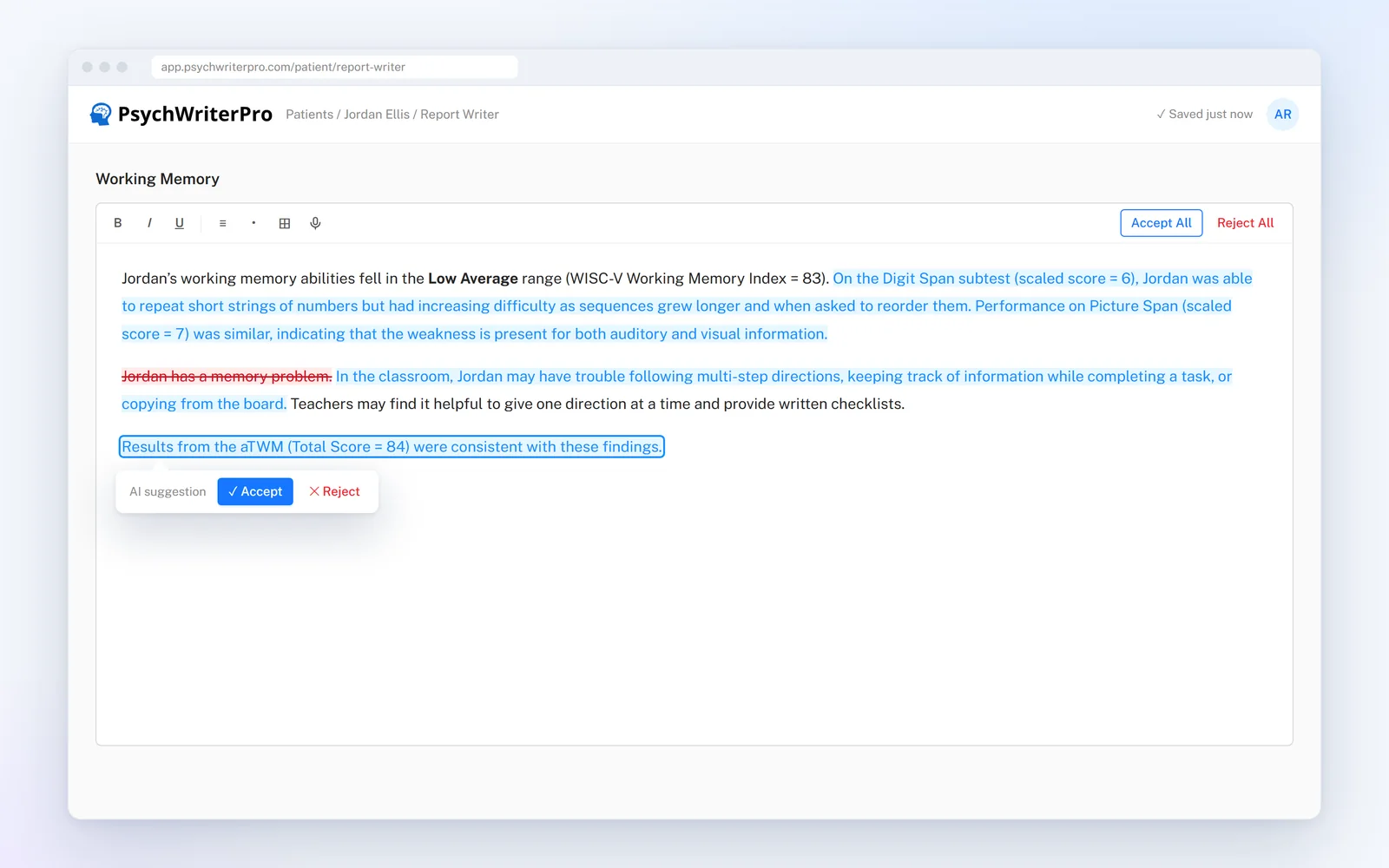
AI drafting from the scores, as tracked changes you accept or reject
One-click export to Word or PDF with your branding
Tests often reported with the WISC-V
All of these are supported, and their scores share the same report tables.
Questions
WISC-V and PsychWriterPro
Does PsychWriterPro score the WISC-V?
No. PsychWriterPro is a report writer, not a scoring service. You enter or import the scores from the publisher's scoring, and PsychWriterPro classifies them, lays out the tables and helps you write the report.
Can I combine the WISC-V with other tests in one report?
Yes. Reports are organized by clinical domain, so WISC-V subtests appear alongside subtests from the other tests you gave, in the table for what they measure. 297+ tests are supported.
What does a WISC-V report look like?
You choose the layout: a full report, tables only, narratives only, or narratives with the tables in an appendix. Reports export to Word or PDF with your letterhead and colors. Sample reports are on the Sample Reports page.
Can I try it first?
Yes. There is a 14-day free trial, and a sample patient is set up for you on day one.
Write your next WISC-V report in PsychWriterPro
Try it free for 14 days, with a sample patient set up for you on day one.
WISC-V is a trademark of its publisher, Pearson. PsychWriterPro is an independent product and is not affiliated with or endorsed by Pearson.