
WAIS-5 report writing, without the busywork
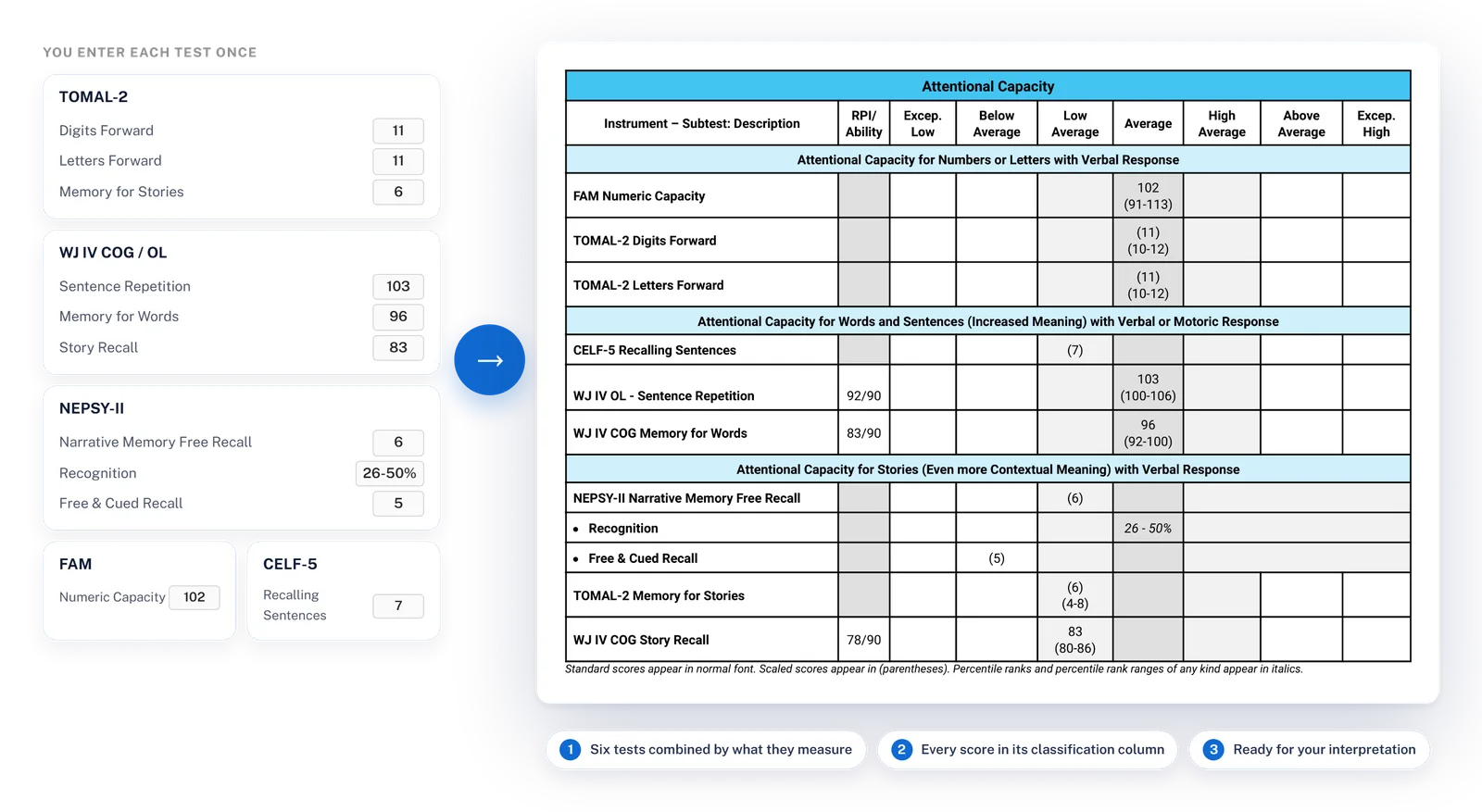
Enter your Wechsler Adult Intelligence Scale | Fifth Edition scores once. PsychWriterPro classifies them, builds the score tables and helps you write the interpretation, then exports a finished report to Word or PDF.
14-day free trial · Cancel anytime
Entered for 800+ patients by PsychWriterPro customers
WAIS-5
What PsychWriterPro does with WAIS-5 scores
Assesses cognitive ability and problem-solving processes of adolescents and adults aged 16 to 90:11 years.
Every score classified
Each WAIS-5 score gets its classification as you enter it, with no manual lookup.
Entry that checks your work
The WAIS-5 entry screen adapts to the form and age you pick, and impossible values are caught before they reach a report.
Placed in the right domain
WAIS-5 results land in the report tables for what they measure, alongside the other tests you gave.
Report coverage
Where WAIS-5 scores appear in your report
PsychWriterPro places 84 WAIS-5 scores into 16 report tables across 10 clinical domains, with confidence intervals where they apply.
- WAIS-5 scores in report tables
- 84
- report tables
- 16
- clinical domains
- 10
Facilitators/Inhibitors: Working Memory
2 tables · 15 scores
Working Memory
Measures a student’s ability to actively manipulate information retrieved from memory.
- WAIS-5 Arithmetic Mentally solving orally presented arithmetic problems within time limits.
- WAIS-5 Arithmetic Mentally solving orally presented arithmetic problems within time limits.
- WAIS-5 Digit Sequencing Recalling digits read to by the examiner in ascending order.
- WAIS-5 Digit Sequencing Recalling digits read to by the examiner in ascending order.
- WAIS-5 Digits Backward Repeating letter strings in reverse order that were spoken by the examiner.
- WAIS-5 Digits Backward Repeating letter strings in reverse order that were spoken by the examiner.
- WAIS-5 Letter-Number Sequencing Recalling numbers in ascending order and letters in alphabetical order.
- WAIS-5 Letter-Number Sequencing Recalling numbers in ascending order and letters in alphabetical order.
- WAIS-5 Spatial Addition Creating a new grid by combing circles based on a set of rules.
- WAIS-5 Spatial Addition Creating a new grid by combing circles based on a set of rules.
- WAIS-5 Symbol Span Selecting previously viewed symbols in sequential order.
- WAIS-5 Symbol Span Selecting previously viewed symbols in sequential order.
Qualitative Behaviors for Working Memory
- Longest Digit Sequence Percentage of same age peers who achieved this number of the longest digit span sequence.
- Longest Digits Backward Percentage of same age peers who achieved this number of the longest digit span backward.
- Longest Letter-Number Sequence Percentage of same age peers who achieved this number of the longest letter-number sequence.
Facilitators/Inhibitors: Speed, Fluency, and Efficiency of Processing
2 tables · 9 scores
Performance Fluency
Measures the student’s ability to quickly perform simple repetitive tasks.
- WAIS-5 Coding Copying symbols paired with geometric shapes or numbers within a time limit.
- WAIS-5 Coding Copying symbols paired with geometric shapes or numbers within a time limit.
- WAIS-5 Symbol Search Scanning a search group and marking the presence or absence of a target symbol or symbols within a time limit.
- WAIS-5 Symbol Search Scanning a search group and marking the presence or absence of a target symbol or symbols within a time limit.
- WAIS-5 Naming Speed Quantity Correctly naming the number of various stacks of blocks on a page as rapidly as possible.
- WAIS-5 Naming Speed Quantity Correctly naming the number of various stacks of blocks on a page as rapidly as possible.
Qualitative Behaviors for Processing Speed and Fluency
- WAIS-5 Naming Speed Quantity Errors Percentage of same age peers who made quality errors naming numbers and letters quickly.
- WAIS-5 Symbol Search Set Errors Percentage of same age peers who made set errors on Symbol Search.
- WAIS-5 Symbol Search Rotation Errors Percentage of same age peers who made rotation errors on Symbol Search.
Cognitive Processes: Executive Functions
2 tables · 8 scores
Problem Solving, Fluid Reasoning, and Planning
Measures the ability to solve problems, apply reasoning skills, and use planning strategies.
- WAIS-5 Set Relations Viewing circles depicting relations and selects the response option that completes the set.
- WAIS-5 Set Relations Viewing circles depicting relations and selects the response option that completes the set.
- WAIS-5 Matrix Reasoning Completing a missing portion of a picture matrix.
- WAIS-5 Matrix Reasoning Completing a missing portion of a picture matrix.
- WAIS-5 Figure Weights Ability to determine what weight is needed to balance a scale.
- WAIS-5 Figure Weights Ability to determine what weight is needed to balance a scale.
Concept Recognition and Generation
Measures ability to recognize or generate multiple ways of classifying or categorizing objects, pictures, or words.
- WAIS-5 Similarities Describing how two words that represent common objects or concepts are similar.
- WAIS-5 Similarities Describing how two words that represent common objects or concepts are similar.
Cognitive Processes: Visuospatial
3 tables · 8 scores
Visuospatial Perception
Measures ability to make visual discriminations, locate objects in space, and construct objects.
- WAIS-5 Block Design Re-creation of a constructed model or a picture of a block design within a specified time limit.
- WAIS-5 Block Design Re-creation of a constructed model or a picture of a block design within a specified time limit.
- WAIS-5 Block Design No Time Bonus Re-creation of a constructed model or a picture of a block design with no time bonus.
- WAIS-5 Block Design Partial Score Partial ability to construct block designs.
Qualitative Behaviors for Visuospatial Processes
- WAIS-5 Block Design Dimension Errors
- WAIS-5 Block Design Rotation Errors
Visuospatial Reasoning
Measures ability to recognize spatial configurations, identify objects with missing parts, and match similar visual patterns.
- WAIS-5 Visual Puzzles Identify two or more pieces that go together to form a complete target shape.
- WAIS-5 Visual Puzzles Identify two or more pieces that go together to form a complete target shape.
Cognitive Processes: Learning and Memory
2 tables · 7 scores
Immediate Verbal Memory
Immediate recall of letters, numbers, words, sentences, and stories quickly after exposure.
- WAIS-5 Digit Span Repeating auditorily presented digits of increasing length.
- Digits Forward Repeating auditorily presented digits of increasing length.
- Digits Forward Repeating auditorily presented digits of increasing length.
- WAIS-5 Running Digits Recalling a specified number of digits in the same order which were read to by the examiner.
- WAIS-5 Running Digits Recalling a specified number of digits in the same order which were read to by the examiner.
Qualitative Behaviors for Immediate Verbal Memory
- WAIS-5 Longest Digits Forward
- WAIS-5 Longest Running Digits
Facilitators/Inhibitors: Allocating and Maintaining Attention
1 table · 6 scores
Attentional Capacity
Measures the ability to learn information with increased content and meaning.
- WAIS-5 Digits Forward Repeating auditorily presented digits of increasing length.
- WAIS-5 Digits Forward Repeating auditorily presented digits of increasing length.
- WAIS-5 Running Digits Recalling a specified number of digits in the same order which were read to by the examiner.
- WAIS-5 Running Digits Recalling a specified number of digits in the same order which were read to by the examiner.
- WAIS-5 Symbol Span Selecting previously viewed symbols in sequential order.
- WAIS-5 Symbol Span Selecting previously viewed symbols in sequential order.
Acquired Knowledge: Acculturation Knowledge
1 table · 4 scores
Semantic Memory
Measures knowledge of basic information retrieved from memory. Semantic memory has three subclassifications within the Integrated SNP/CHC Model: verbal comprehension, general information, and domain-specific knowledge.
- WAIS-5 Comprehension Answering questions based on understanding of general principles and social situations.
- WAIS-5 Comprehension Answering questions based on understanding of general principles and social situations.
- WAIS-5 Information Answering questions about a wide range of general knowledge topics.
- WAIS-5 Information Answering questions about a wide range of general knowledge topics.
Basic Sensorimotor Functions
1 table · 4 scores
Visual Scanning / Tracking
Measures ability to visually scan information.
- WAIS-5 Coding Copying symbols paired with geometric shapes or numbers within a time limit.
- WAIS-5 Coding Copying symbols paired with geometric shapes or numbers within a time limit.
- WAIS-5 Symbol Search Scanning a search group and marking the presence or absence of a target symbol or symbols within a time limit.
- WAIS-5 Symbol Search Scanning a search group and marking the presence or absence of a target symbol or symbols within a time limit.
Acquired Knowledge: Language Abilities
1 table · 2 scores
Oral Expression
Measures knowledge of word meanings.
- WAIS-5 Vocabulary Ability to name pictured objects or define word meanings.
- WAIS-5 Vocabulary Ability to name pictured objects or define word meanings.
Included
Everything you need to write up the WAIS-5
Scores validated as you enter them
Classifications filled in automatically
Ready-made score tables, organized by clinical domain
A Word-style editor under every table for your interpretation
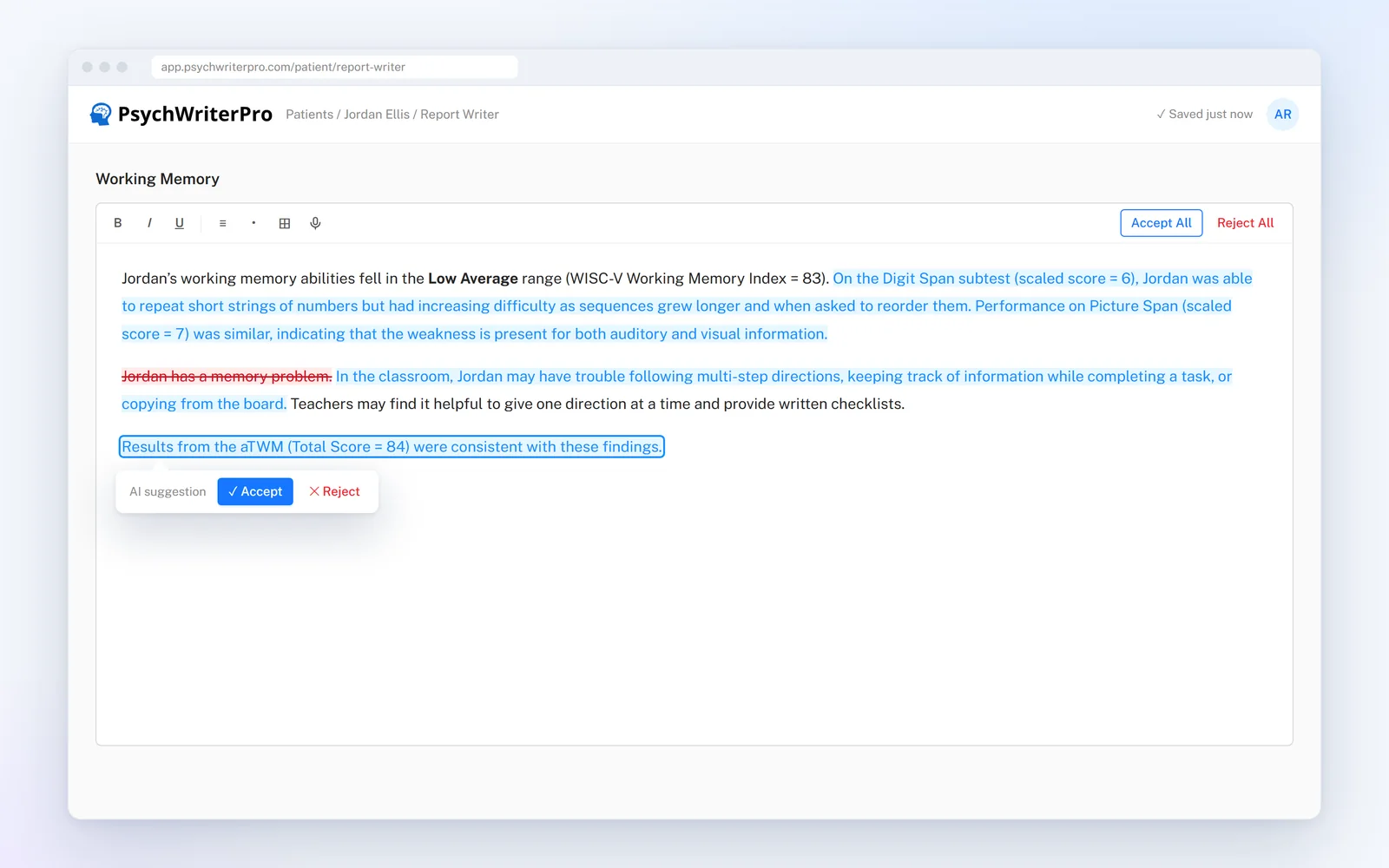
AI drafting from the scores, as tracked changes you accept or reject
One-click export to Word or PDF with your branding
Tests often reported with the WAIS-5
All of these are supported, and their scores share the same report tables.
Questions
WAIS-5 and PsychWriterPro
Does PsychWriterPro score the WAIS-5?
No. PsychWriterPro is a report writer, not a scoring service. You enter or import the scores from the publisher's scoring, and PsychWriterPro classifies them, lays out the tables and helps you write the report.
Can I combine the WAIS-5 with other tests in one report?
Yes. Reports are organized by clinical domain, so WAIS-5 subtests appear alongside subtests from the other tests you gave, in the table for what they measure. 297+ tests are supported.
What does a WAIS-5 report look like?
You choose the layout: a full report, tables only, narratives only, or narratives with the tables in an appendix. Reports export to Word or PDF with your letterhead and colors. Sample reports are on the Sample Reports page.
Can I try it first?
Yes. There is a 14-day free trial, and a sample patient is set up for you on day one.
Write your next WAIS-5 report in PsychWriterPro
Try it free for 14 days, with a sample patient set up for you on day one.
WAIS-5 is a trademark of its publisher, Pearson. PsychWriterPro is an independent product and is not affiliated with or endorsed by Pearson.