
PsychWriterPro
Free Trial

D-KEFS report writing, without the busywork

Enter your Delis-Kaplan Executive Function System scores once. PsychWriterPro classifies them, builds the score tables and helps you write the interpretation, then exports a finished report to Word or PDF.

Start Free TrialView Sample Reports

14-day free trial · Cancel anytime

Entered for 2,500+ patients by PsychWriterPro customers
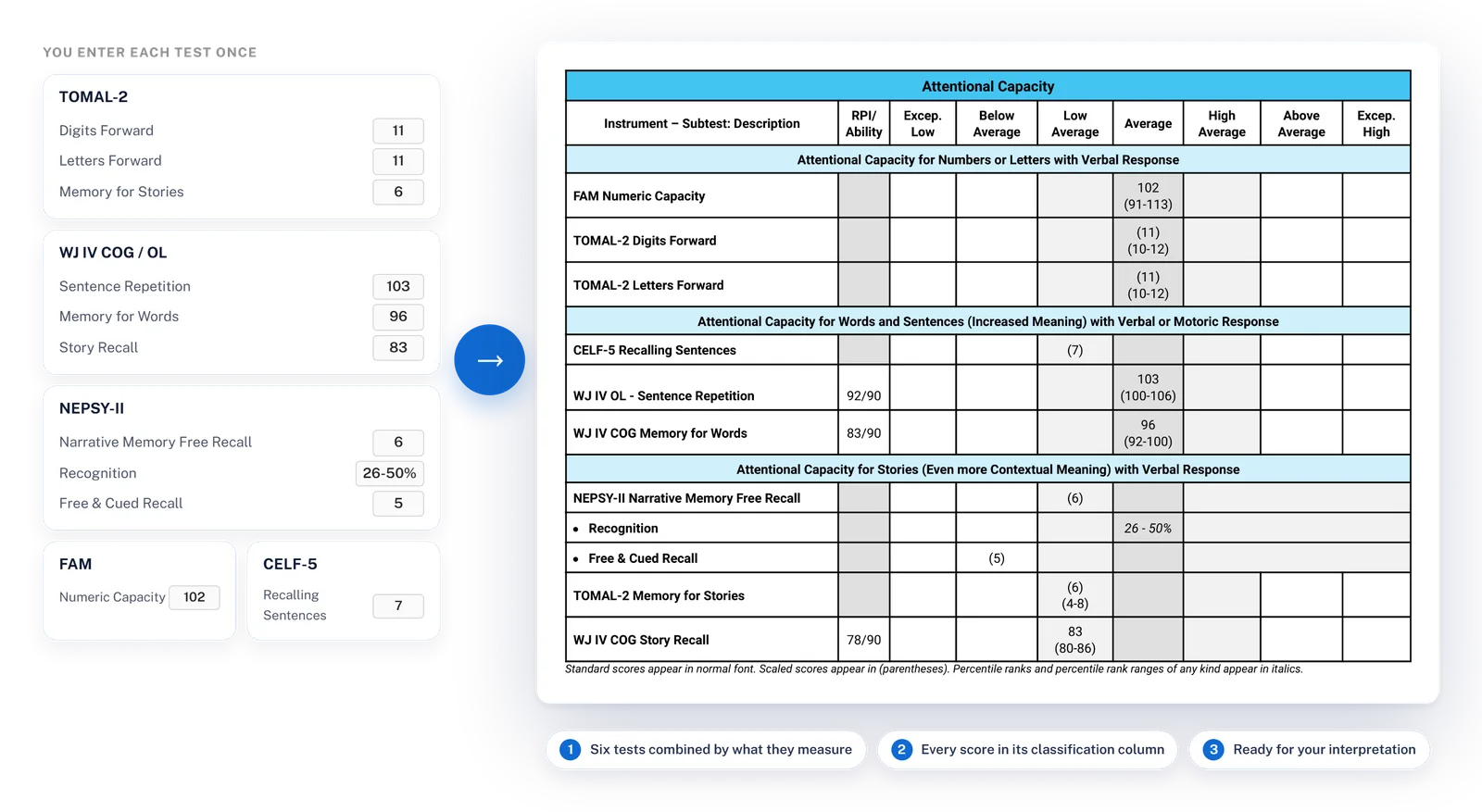
Scores from several tests, including the D-KEFS, combined into one classified report table

D-KEFS

What PsychWriterPro does with D-KEFS scores

Comprehensive assessment of executive functions, in children and adults, ages 8 to 89 years.

Every score classified

Each D-KEFS score gets its classification as you enter it, with no manual lookup.

Entry that checks your work

The D-KEFS entry screen adapts to the form and age you pick, and impossible values are caught before they reach a report.

Placed in the right domain

D-KEFS results land in the report tables for what they measure, alongside the other tests you gave.

Report coverage

Where D-KEFS scores appear in your report

PsychWriterPro places 139 D-KEFS scores into 11 report tables across 5 clinical domains, with confidence intervals where they apply.

D-KEFS scores in report tables
139
report tables
11
clinical domains
5

Cognitive Processes: Executive Functions

5 tables · 117 scores

Qualitative Behaviors for Executive Functions

  • D-KEFS Trail-Making Condition 1 – Visual Scanning: Commission Errors
  • D-KEFS Color-Word Interference Test: Condition 3 – Inhibition Total Corrected Errors
  • D-KEFS Color-Word Interference Test: Condition 4 Total – Inhibition/ Switching Corrected Errors
  • D-KEFS Verbal Fluency Test First Interval (1” – 15”) Total Correct
  • D-KEFS Verbal Fluency Test Second Interval (16” – 30”) Total Correct
  • D-KEFS Verbal Fluency Test Third Interval (31” – 45”) Total Correct
  • D-KEFS Verbal Fluency Test Fourth Interval (46” – 60”) Total Correct
  • D-KEFS Tower Test: Mean First Move Time: Indicator or reflective or impulsive behavior.
  • D-KEFS Tower Test: Time-Per-Move Ratio
  • D-KEFS Trail Making Test Condition 1 - Visual Scanning Omission Errors
  • D-KEFS Design Fluency Test: Percent Design Accuracy
  • D-KEFS Sorting Test Condition 1 – Percent Sorting Accuracy
  • D-KEFS Sorting Test Condition 1 – Time-Per-Sort Ratio
  • D-KEFS Tower Test: Move Accuracy Ratio
  • D-KEFS Verbal Fluency Test Category Switching: Percent Switching Accuracy
  • D-KEFS Design Fluency Test: Total Repeated Designs
  • D-KEFS Proverbs Test Free Inquiry Repeated Responses
  • D-KEFS Sorting Test Condition 1 Repeated Sorts
  • D-KEFS Sorting Test - Condition 1 Free Sorting Repeated Descriptions
  • D-KEFS Sorting Test - Condition 1 Free Sorting Percent Description Accuracy
  • D-KEFS Sorting Test Condition 2 Sort Recognition Repeated Descriptions
  • D-KEFS Sorting Test – Combined Repeated Descriptions
  • D-KEFS Twenty Questions Test: Repeated Questions
  • D-KEFS Verbal Fluency Test: Repetition Errors
  • D-KEFS Verbal Fluency Test: Percent Repetition Errors
  • D-KEFS Tower Test Total Rule Violations
  • D-KEFS Tower Test Rule Violations-Per-Item Ratio
  • D-KEFS Trail Making Test: Condition 2 – Number Sequencing: Sequencing Errors
  • D-KEFS Trail Making Test: Condition 3 – Letter Sequencing: Sequencing Errors
  • D-KEFS Trail Making Test: Condition 4 – Number-Letter Switching: Sequencing Errors
  • D-KEFS Design Fluency Test: Total Set-Loss Designs
  • D-KEFS Sort Test Condition 1 Set-Loss Sorts
  • D-KEFS Sort Test Nontarget Even Sorts
  • D-KEFS Trail Making Test: Condition 2 – Number Sequencing Set-Loss Errors
  • D-KEFS Trail Making Test: Condition 3 – Letter Sequencing Set-Loss Errors
  • D-KEFS Trail Making Test: Condition 4 – Number-Letter Switching Set-Loss Errors
  • D-KEFS Twenty Questions Test: Set-Loss Questions
  • D-KEFS Verbal Fluency Test: Set-Loss Errors
  • D-KEFS Verbal Fluency Test: Percent Set-Loss Errors
  • D-KEFS Word Context Test: Total Correct-to-Incorrect Errors
  • D-KEFS Trail Making Test: Condition 2 – Number Sequencing: Time Discontinue Errors
  • D-KEFS Trail Making Test: Condition 3 – Letter Sequencing: Time Discontinue Errors
  • D-KEFS Trail Making Test: Condition 4 – Number – Letter Switching: Time Discontinue Errors
  • D-KEFS Trail Making Test: Condition 5 – Motor Speed: Time Discontinue Errors
  • D-KEFS Design Fluency Test: Total Attempted Designs
  • D-KEFS Sort Test Condition 1 Attempted Sorts
  • D-KEFS Color-Word Interference Test: Condition 3 – Inhibition Uncorrected Errors
  • D-KEFS Color-Word Interference Test: Condition 4 – Inhibition/Switching Uncorrected Errors

Concept Recognition and Generation

Measures ability to recognize or generate multiple ways of classifying or categorizing objects, pictures, or words.

  • D-KEFS Sorting Test Recognition Total Description Ability to describe sorting concepts or rules used by the examiner to sort the cards.
  • Sort Recognition Description – Card Set 1 Ability to describe sorting concepts or rules used by the examiner to sort the cards.
  • Sort Recognition Description – Card Set 2 Ability to describe sorting concepts or rules used by the examiner to sort the cards.
  • Sort Recognition Incorrect Descriptions Reflects inaccurate descriptions by the examinee of the card sorts completed by the examiner.
  • D-KEFS Twenty Questions Test Initial Abstraction Level of abstract reasoning in the first questions asked.
  • Total Questions Asked The fewer the questions asked the better.
  • Total Weighted Achievement This score used if the child guesses the correct answer quickly.
  • D-KEFS Sorting Test Condition 1 – Free Sorting Confirmed Correct Sorts The number of confirmed correct sorts made on the two card sets.
  • Confirmed Correct Sorts: Card Set 1
  • Confirmed Correct Sorts: Card Set 2
  • D-KEFS Sorting Test Condition 1 – Free Sorting Description Ability to describe sorting concepts or rules used in sorting the cards for two card sets.
  • Confirmed Correct Verbal Sorts Tendency to rely on verbal descriptions for explaining the card sorts.
  • Confirmed Correct Perceptual Sorts Tendency to rely on visual-spatial details for explaining the card sorts.
  • Confirmed/Unconfirmed Target Sorts The ability to correctly verify the reasons for the card sorts.
  • Free Sorting Description: Card Set 1 Ability to describe sorting concepts or rules used in sorting card set 1.
  • Free Sorting Description: Card Set 2 Ability to describe sorting concepts or rules used in sorting card set 2.
  • Free Sorting Incorrect Descriptions Reflects inaccurate descriptions of the two card sorts generated by the examinee.
  • D-KEFS Sorting Test Combined Description Score Ability to describe sorting concepts used by examinee or examiner.
  • Combined Description Score Verbal Rules This score reflects a tendency to emphasize the verbal attributes of the card sort descriptions.
  • Combined Description Score Perceptual Rules This score reflects a tendency to-emphasize the perceptual attributes of the card sort descriptions.
  • Combined Description Score No/Don’t Know Responses This score reflects an examinee’s limited response style.
  • Combined Description Score Noncredit Descriptions This score reflects an examinee’s creative or out of the norm descriptions of the sorts.
  • Combined Description Score Overly Abstract Descriptions This score reflects an examinee’s overly abstract descriptions of the card sorts.
  • Combined Description Score Incorrect Descriptions This score reflects an examinee’s incorrect descriptions of the card sorts.
  • Sort Recognition versus Free Sorting Description Contrast A contrast score comparing the difference between the ability to recognize a sort and to describe a sort.

Cognitive Flexibility (Set Shifting)

Measures ability to stop focusing on one activity and start focusing on another activity.

  • D-KEFS Color-Word Interference Test Condition 4: Inhibition/Switching Rapidly switch back and forth between naming the ink colors and reading the words.
  • Inhibition/Switching Total Errors Total uncorrected and corrected errors (more errors = lower SS)
  • Inhibition/Switching vs. Combined Naming + Reading Contrast Possible limiting effects of poor color naming and word reading on inhibition/switching or inhibition/switching deficits above and beyond any color and word naming deficits.
  • Inhibition/Switching vs. Color Naming Contrast Possible limiting effects of poor color naming on inhibition/switching or inhibition/switching deficits above and beyond any color naming deficits.
  • Inhibition/Switching vs. Word Reading Contrast Possible limiting effects of poor word reading on inhibition/switching or inhibition/switching deficits above and beyond any word reading deficits.
  • Inhibition/Switching vs. Inhibition Contrast Possible limiting effects of inhibition on inhibition/switching or inhibition/switching deficits above and beyond any inhibition deficits.
  • D-KEFS Verbal Fluency Test Condition 3 - Category Switching Total Correct Responses Total number of correct responses when switching between verbalizing fruits and pieces of furniture.
  • D-KEFS Verbal Fluency Test Condition 3 – Category Switching Total Switching Accuracy The correct number of switches between verbal categories.
  • D-KEFS Verbal Fluency Test Category Switching vs. Category Fluency Difference between switching accuracy and production of multiple categories.
  • D-KEFS Design Fluency Test Condition 3 – Switching Total Correct Switching between connecting solid dots and empty dots.
  • D-KEFS Trail Making Test Condition 4 (Number-Letter Switching) Time taken to switch between number and letter sequences (e.g., 1-A-2-B…).
  • D-KEFS Trail Making Test Condition 4 (Number-Letter Switching) Total All Errors Total errors made when switching between number and letter sequences (e.g., 1-A-2-B…).
  • Condition 1 - Visual Scanning Time taken to mark all of one number of a page.
  • Condition 2 - Number Sequencing Time taken to connect lines between consecutive numbers.
  • Condition 3 - Letter Sequencing Time taken to connect lines between sequential letters.
  • Combined Number Sequencing + Letter Sequencing Time taken across number and letter trials.
  • Condition 5 - Motor Speed Time taken to trace a dotted line as quickly as possible.
  • Number-Letter Switching vs. Visual Scanning Contrast Score
  • Number-Letter Switching vs. Number Sequencing Contrast Score
  • Number-Letter Switching vs. Letter Sequencing Contrast Score
  • Number-Letter Switching vs. Combined Number Sequencing + Letter Sequencing Contrast Score
  • Number-Letter Switching vs. Motor Speed Contrast Score

Problem Solving, Fluid Reasoning, and Planning

Measures the ability to solve problems, apply reasoning skills, and use planning strategies.

  • D-KEFS Tower Test Total Achievement Overall quality of tower building within time limits.
  • D-KEFS Proverbs Test Total Achievement: Free Inquiry Knowledge of verbal proverbs.
  • Common Proverb Achievement Free Inquiry Ability to explain common proverbs.
  • Uncommon Proverb Achievement Free Inquiry Ability to explain uncommon proverbs.
  • Accuracy Only Ability to provide accurate interpretations.
  • Abstraction Only Ability to provide accurate abstractions.
  • No/Don’t Know Responses A low score indicates a lack of responses on the task.
  • D-KEFS Proverbs Test Total Achievement: Multiple Choice Recognition of verbal proverbs.
  • Common Proverbs Achievement Multiple Choice Ability to recognize the meaning of common proverbs.
  • Uncommon Proverbs Achievement Multiple Choice Ability to recognize the meaning of uncommon proverbs.
  • Total Correct Abstract Choices Ability to correctly identify abstract statements that describe a proverb.
  • Total Correct Concrete Choices Correctly identify statements that describe a proverb but at a concrete level.
  • Total Incorrect Phonemic Choices Incorrectly identify statements that describe a proverb based on a statement that sounds the same.
  • Total Incorrect Unrelated Choices Incorrectly identify statements that describe a proverb based on a statement that is unrelated in any way.
  • Total Incorrect Phonemic + Unrelated Choices Total of all incorrect choices.
  • D-KEFS Word Context Test Total Consecutively Correct Verbal abstract deductive reasoning.
  • Consistently Correct Ratio Low score indicates increased distractibility and stimulus-bound tendencies.
  • Repeated Incorrect Responses A low score indicates many repeated incorrect responses, which reflects impairment in flexibility of thinking.
  • No/Don’t Know Responses A low score indicates a lack of responses on the task.

Response Inhibition

Measures the ability to learn and demonstrate a new response to a stimulus instead of producing a typical response.

  • D-KEFS Color-Word Interference Test Condition 3 Inhibition Time to rapidly name the color of the ink a color word (“red”) is printed in.
  • Inhibition vs. Color Naming Contrast Possible limiting effects of poor color naming on inhibition or inhibition deficits above and beyond any color naming deficits.
  • Inhibition Total Errors Total uncorrected and corrected errors. (more errors = lower SS)

Performance Fluency

Measures the student’s ability to quickly perform simple repetitive tasks.

  • D-KEFS - Trail Making Test Condition 5 – Motor Speed Tracing a dotted line as quickly as possible.
  • D-KEFS Design Fluency Test Total Correct Composite The total number correct across Conditions 1, 2 & 3.
  • D-KEFS Design Fluency Test Total Combined Filled Dots + Empty Dots Composite The total number correct across Conditions 1 & 2.
  • Condition 1 - Filled Dots Total Correct Connects filled dots to create as many different designs as possible in 60 seconds.
  • Condition 2 - Empty Dots Total Correct Connects empty dots to create as many different designs as possible in 60 seconds.
  • Switching vs. Combined Filled Dots + Empty Dots Contrast Difference between the switching and non-switching conditions.
  • D-KEFS Color-Word Interference Test - Condition 1: Color Naming Time to name the color of colored squares rapidly.
  • Color Naming Total Errors Total number of uncorrected and corrected errors.
  • D-KEFS Color-Word Interference Test - Condition 2: Word Reading Time to name color words (e.g., “red”) rapidly.
  • Word Reading Total Errors Total number of uncorrected and corrected errors.
  • D-KEFS Color-Word Interference Test Combined Naming + Reading Composite Time to name both the name of the colors and the color words combined.

Fluency with Accuracy

  • D-KEFS Color-Word Interference Test: Color Naming
  • D-KEFS Color-Word Interference Test: Word Reading
  • D-KEFS Color-Word Interference Test: Inhibition Condition
  • D-KEFS Color-Word Interference Test: Inhibition/Switching Condition

Retrieval Fluency

Measures the student’s ability to quickly access information from long-term memory.

  • D-KEFS Verbal Fluency Test – Condition 1: Letter Fluency Total Correct Naming as many words within a time limit that start with a specific letter.
  • D-KEFS Verbal Fluency Test – Condition 2: Category Fluency Total Correct Naming as many words within a time limit that all fall in the same category (e.g., fruits).
  • D-KEFS Verbal Fluency Test – Letter Fluency vs. Category Fluency Difference between letter and category fluency.

Reading Achievement

Measures academic skills that require reading.

  • D-KEFS Sorting Test Word Reading Errors Screening pretest to determine word reading skill level
  • D-KEFS Sorting Test Word Comprehension Errors Screening pretest to determine word comprehension skill level.

Qualitative Behaviors for Oral Expression

  • D-KEFS Twenty Question Test: Spatial Questions

Visual Scanning / Tracking

Measures ability to visually scan information.

  • D-KEFS Trail Making Test Condition 1: Visual Scanning All of the number 3s on a page are marked as quickly as possible.

Included

Everything you need to write up the D-KEFS

  • Scores validated as you enter them

  • Classifications filled in automatically

  • Ready-made score tables, organized by clinical domain

  • A Word-style editor under every table for your interpretation

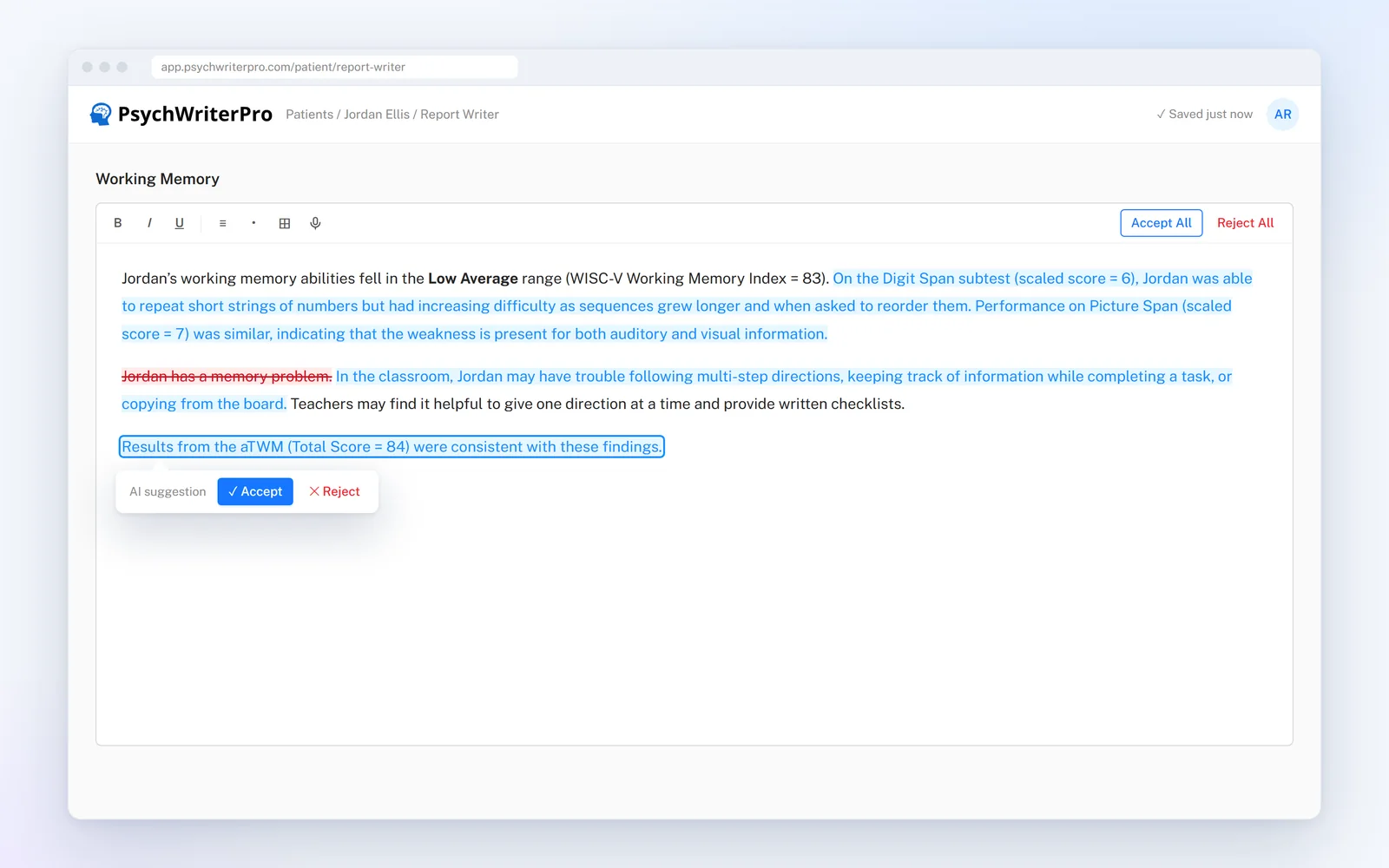
  • AI drafting from the scores, as tracked changes you accept or reject

  • One-click export to Word or PDF with your branding
See all features
An interpretation drafted from the scores, shown as tracked changes to accept or reject

Tests often reported with the D-KEFS

All of these are supported, and their scores share the same report tables.

Delis-Kaplan Executive Function System Advanced (D-KEFS-Advanced)Behavior Rating Inventory of Executive Function, Second Edition (BRIEF2)Wisconsin Card Sorting Test (WCST)NEPSY, Second Edition (NEPSY-II)Wechsler Intelligence Scale for Children, Fifth Edition (WISC-V)
See all 297 supported tests →

Questions

D-KEFS and PsychWriterPro

Does PsychWriterPro support the D-KEFS?

Yes. The Delis-Kaplan Executive Function System (D-KEFS) is fully supported, with its own score entry screen, automatic classifications and report tables.

No. PsychWriterPro is a report writer, not a scoring service. You enter or import the scores from the publisher's scoring, and PsychWriterPro classifies them, lays out the tables and helps you write the report.

Yes. Reports are organized by clinical domain, so D-KEFS subtests appear alongside subtests from the other tests you gave, in the table for what they measure. 297+ tests are supported.

You choose the layout: a full report, tables only, narratives only, or narratives with the tables in an appendix. Reports export to Word or PDF with your letterhead and colors. Sample reports are on the Sample Reports page.

Yes. There is a 14-day free trial, and a sample patient is set up for you on day one.

Write your next D-KEFS report in PsychWriterPro

Try it free for 14 days, with a sample patient set up for you on day one.

Start Free TrialBook a Demo Call

D-KEFS is a trademark of its publisher, Pearson. PsychWriterPro is an independent product and is not affiliated with or endorsed by Pearson.