
NEPSY-II report writing, without the busywork
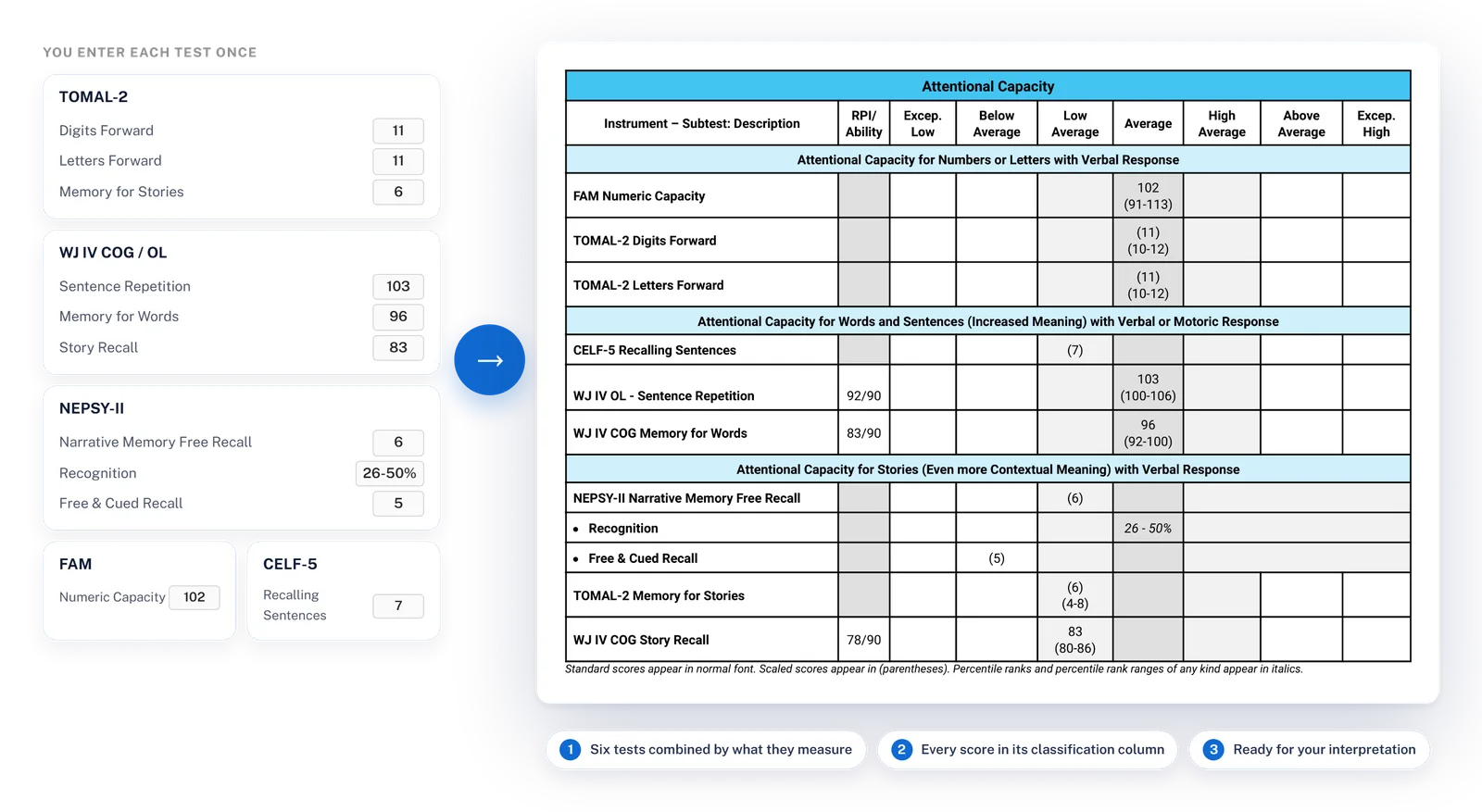
Enter your NEPSY, Second Edition scores once. PsychWriterPro classifies them, builds the score tables and helps you write the interpretation, then exports a finished report to Word or PDF.
14-day free trial · Cancel anytime
Entered for 3,000+ patients by PsychWriterPro customers
NEPSY-II
What PsychWriterPro does with NEPSY-II scores
A comprehensive instrument designed to assess neuropsychological functioning in preschool and school-age children ages 3 to 16 years.
Every score classified
Each NEPSY-II score gets its classification as you enter it, with no manual lookup.
Learning-curve graphs, built in
Learning-curve graphs for the NEPSY-II are added to the report automatically.
Placed in the right domain
NEPSY-II results land in the report tables for what they measure, alongside the other tests you gave.
Report coverage
Where NEPSY-II scores appear in your report
PsychWriterPro places 186 NEPSY-II scores into 29 report tables across 10 clinical domains, with confidence intervals where they apply.
- NEPSY-II scores in report tables
- 186
- report tables
- 29
- clinical domains
- 10
Cognitive Processes: Executive Functions
4 tables · 30 scores
Cognitive Flexibility (Set Shifting)
Measures ability to stop focusing on one activity and start focusing on another activity.
- NEPSY-II Inhibition Total Errors (Ages 7-16) Total errors across all three conditions (more errors = lower scaled score).
- NEPSY-II Inhibition Switching Combined Rapidly and accurately name shapes while switching cognitive sets.
- Total Completion Time How quickly the task was completed (slower time = lower scaled score).
- Total Errors Total errors made on the task (more errors = lower % rank).
- Uncorrected Errors Errors with no attempt to correct (more errors = lower % rank).
- Self-Corrected Errors Errors that were self-corrected (more self-corrections = lower % rank).
- NEPSY-II Inhibition Inhibition Condition vs. Switching Condition Comparison scores between the two conditions.
- NEPSY-II Response Set Combined Score Ability to shift, and selectively attend to targets over time.
- Total Commission Errors Responding to non-target words that were to be ignored (more errors = lower % rank).
- Total Correct Responding correctly to target words (more correct = higher scaled score).
- Total Omission Errors Missing target words (more errors = lower % rank).
- Total Inhibitory Errors Ignoring distracter words (more errors = lower % rank).
- NEPSY-II Auditory Attention vs. Response Set Contrast Score Auditory Attention vs. Response Contrast Score
Response Inhibition
Measures the ability to learn and demonstrate a new response to a stimulus instead of producing a typical response.
- NEPSY-II Inhibition (Condition 2) Combined Rapidly and accurately naming the opposite names of shapes (e.g., “circle” for “square”).
- Completion Time How quickly the task was completed. (slower time = lower scaled score)
- Errors Total errors made on the task. (more errors = lower % rank)
- Uncorrected Errors Errors with no attempt to correct (more errors = lower % rank).
- Self-Corrected Errors Errors that were self-corrected (more self-corrections = lower % rank).
- NEPSY-II Inhibition Total Errors (Ages 5-6) Total errors across all first two conditions (more errors = lower % rank).
- NEPSY-II Statue Total Maintaining a body position during distractions.
- Body Movement Inhibitory Errors Number of times moved during the task.
- Eye Opening Inhibitory Errors Number of times opened eyes during the task.
- Vocalization Inhibitory Errors Number of times talked during the task.
Concept Recognition and Generation
Measures ability to recognize or generate multiple ways of classifying or categorizing objects, pictures, or words.
- NEPSY-II Animal Sorting Combined Number of correct sorts and the number of errors.
- Correct Sorts A high score suggests good initiation or sustained effort, good conceptual reasoning or semantic knowledge.
- Errors A low number of errors suggests good self-monitoring (more errors = lower % rank).
- Novel Sort Errors A high score suggests idiosyncratic or immature reasoning (more errors = lower % rank).
- Repeated Sort Errors A high score suggests poor cognitive flexibility and self-monitoring (more errors = lower % rank).
Qualitative Behaviors for Executive Functions
- NEPSY-II Memory for Designs Immediate and Delayed Rule Violations (Age Comparison)
- NEPSY-II Memory for Designs Immediate and Delayed Rule Violations (Clinical Comparison)
Cognitive Processes: Learning and Memory
6 tables · 30 scores
Immediate Verbal Memory
Immediate recall of letters, numbers, words, sentences, and stories quickly after exposure.
- NEPSY-II Repetition of Nonsense Words Total Repetition of nonsense words.
- NEPSY-II Word List Interference Recall Repeating an initial string of unrelated words after a second interference list of unrelated words is presented.
- NEPSY-II Word List Interference Repetition Repeating an initial string of unrelated words.
- NEPSY-II Sentence Repetition Immediate recall of sentences of increasing length and complexity.
- NEPSY-II Narrative Memory Free Recall Details recalled from orally presented stories.
- Recognition Details recognized from orally presented stories.
- Free & Cued Recall Details recalled freely and with cues from orally presented stories.
- NEPSY-II Narrative Memory Free and Cued vs. Recognition Contrast Comparison between the two scores.
Delayed Visual Memory
Recall and recognition of previously learned visual details.
- NEPSY-II Memory for Designs Delayed Total Delayed recall of abstract designs.
- Delayed Content Delayed recall of design elements.
- Delayed Spatial Delayed recall of spatial location of design elements.
- Delayed Content vs. Spatial Contrast Comparison between the two scores.
- NEPSY-II Memory for Designs Immediate vs. Delayed Recall Comparison between the two scores.
- NEPSY-II Memory for Faces Delayed Total Delayed recall of previously learned target faces.
- NEPSY-II Memory for Faces Immediate vs. Delayed Recall Comparison between the two scores.
Immediate Visual Memory
Immediate recall of presented visual details.
- NEPSY-II Memory for Designs Total Placing elements of an abstract design into a grid after briefly looking at an abstract design.
- Content Correctly identifying design elements.
- Spatial Correctly identifying spatial location of design elements.
- Immediate Content vs. Spatial Contrast Comparison between the two scores.
- NEPSY-II Memory for Faces Total Score Picking out faces from many faces that were previously seen.
Rate of Learning
Measures the ability to learn new information over repeated trials.
- NEPSY-II List Memory Learning Effect Correctly recalled words on last trial minus correctly recalled words on the first trial.
- NEPSY-II List Memory Interference Effect Recalling a second list of words after the first list is presented.
- Repetitions The number of repeated words recalled from a list.
- Non-List Words The number of words recalled that were not on the list (novel errors).
- Wrong List Words The number of words recalled from a previous list of words (interference effect).
Verbal-Visual Associative Learning and Recall
Measures ability to learn and remember information that requires both verbal and visual associations.
- NEPSY-II Memory for Names Total Recalling names associated with faces over repeated trials.
- NEPSY-II Memory for Names Delayed Total Recalling, after a delay, names associated with faces.
- NEPSY-II Memory for Names and Memory for Names Delayed Total Score Immediate Correct vs. Delayed Correct
Delayed Verbal Memory
Recall and recognition of previously learned verbal details.
- NEPSY-II List Memory Delayed Effect The number of correctly recalled words on Trial 5 minus the number of correctly recalled words on the delayed recall trial.
- NEPSY-II List Memory and List Memory Delayed Total Score Total number of correctly recalled words for immediate and delayed lists.
Facilitators/Inhibitors: Speed, Fluency, and Efficiency of Processing
3 tables · 25 scores
Performance Fluency
Measures the student’s ability to quickly perform simple repetitive tasks.
- NEPSY-II Visuomotor Precision Combined Tracing a path from a start to finish quickly and while trying to stay with the lines.
- Total Completion Time (slower completion time = lower scaled score)
- Total Errors (more errors = lower % rank)
- Pencil Lift (more errors = lower % rank)
- NEPSY-II Design Fluency Total Connecting dots with unique line patterns.
- Structured Array
- Random Array
- NEPSY-II Inhibition: Naming Combined Rapidly and accurately name shapes.
- Completion Time How quickly the task was completed (slower time = lower scaled score).
- Naming Errors Total errors made on the task (more errors = lower % rank).
- Uncorrected Errors Errors with no attempt to correct (more errors = lower % rank).
- Self-Corrected Errors Errors that were self-corrected (more self-corrections = lower % rank).
- NEPSY-II Speeded Naming Combined Rapidly naming attributes of objects or a series of numbers and letters.
- Completion Time How quickly the task was completed (slower time = lower scaled score).
- Total Correct How accurately the task was completed (more correct = higher % rank).
- Self-Corrected Errors Awareness of errors made on the task with self-correction (more self-corrections = lower % rank).
- NEPSY-II Oromotor Sequences Repetition of articulatory sequences like tongue twisters.
Fluency with Accuracy
- NEPSY-II Speeded Naming
- NEPSY-II Visuomotor Precision
- NEPSY-II Inhibition: Naming
- NEPSY-II Inhibition: Inhibition
- NEPSY-II Inhibition: Switching
Retrieval Fluency
Measures the student’s ability to quickly access information from long-term memory.
- NEPSY-II Word Generation Initial Letter Total Words recalled quickly that start with a particular letter.
- NEPSY-II Word Generation Semantic Total Words recalled quickly that fit into a category.
- NEPSY-II Word Generation Semantic vs. Initial Letter Contrast Comparison between the two scores.
Acquired Knowledge: Language Abilities
3 tables · 16 scores
Qualitative Behaviors for Receptive Language
- NEPSY-II Comprehension of Instructions (Age Comparison)
- NEPSY-II Comprehension of Instructions (Insert clinical group used)
- NEPSY-II Phonological Processing (Age Comparison)
- NEPSY-II Phonological Processing (Insert clinical group used)
- NEPSY-II Sentence Repetition (Age Comparison)
- NEPSY-II Sentence Repetition (Insert clinical group used)
- NEPSY-II Word List Interference (Age Comparison)
- NEPSY-II Word List Interference (Insert clinical group used)
Qualitative Behaviors for Oral Expression
- NEPSY-II Oromotor Sequences (Age Comparison)
- NEPSY-II Oromotor Sequences (Age Comparison)
- NEPSY-II Oromotor Sequences (Insert clinical group used)
- NEPSY-II Oromotor Sequences (Age Comparison)
- NEPSY-II Oromotor Sequences (Insert clinical group used)
- NEPSY-II Repetition of Nonsense Words (Age Comparison)
- NEPSY-II Repetition of Nonsense Words (Insert clinical group used)
Receptive Language (Listening Comprehension)
Measures the ability to understand spoken language.
- NEPSY-II Comprehension of Instructions Total Respond quickly to verbal instructions of increasing complexity.
Facilitators/Inhibitors: Allocating and Maintaining Attention
3 tables · 14 scores
Attentional Capacity
Measures the ability to learn information with increased content and meaning.
- NEPSY-II Repetition of Nonsense Words Total Repetition of nonsense words.
- NEPSY-II Sentence Repetition Repeating sentences of increased length and complexity.
- NEPSY-II Narrative Memory Free Recall Recalling orally presented story details.
- Recognition Details recognized from orally presented stories.
- Free & Cued Recall Details recalled freely and with cues from orally presented stories.
Selective/Focused and Sustained Attention
Measures ability to identify targets (visual or auditory) that are embedded among many distractors or filtering extraneous information and measures the ability to pay attention over prolonged periods of time.
- NEPSY-II Auditory Attention Combined Selectively respond to auditory target words while ignoring auditory non-target words.
- Commission Errors Responding to non-target words that were to be ignored (more errors = lower % rank).
- Total Correct Responding correctly to target words (more correct = higher scaled score).
- Omission Errors Missing target words (more errors = lower % rank).
- Inhibitory Errors Ignoring distracter words. (More errors = lower % rank).
Qualitative Behaviors for Attentional Processes
- NEPSY-II Auditory Attention and Response Set: Inattentive/Distracted Off-Task Behaviors (Age Comparison)
- NEPSY-II Auditory Attention and Response Set: Inattentive/Distracted Off-Task Behaviors (Insert clinical group used)
- NEPSY-II Auditory Attention and Response Set: Out of Seat/Physical Movement in Seat Off-Task Behaviors (Age Comparison)
- NEPSY-II Auditory Attention and Response Set: Out of Seat/Physical Movement in Seat Off-Task Behaviors (Insert clinical group used)
Social-Emotional Functioning and Adaptive Behaviors
2 tables · 13 scores
Social Perception
Ability to recognize other people’s emotions or take the perspective of others.
- NEPSY-II Affect Recognition Total Ability to recognize emotions in pictures of faces.
- Total Happy Errors
- Total Sad Errors
- Total Neutral Errors
- Total Fear Errors
- Total Angry Errors
- Total Disgust Errors
- NEPSY-II Theory of Mind Total Ability to take the perspective of others.
- Theory of Mind Verbal Score Verbal items related to perspective taking.
Qualitative Behaviors for Social-Emotional Functioning
- NEPSY-II - Memory for Faces and Memory for Faces Delayed (Age Comparison)
- NEPSY-II - Memory for Faces and Memory for Faces Delayed (Insert clinical group used)
- NEPSY-II - Affect Recognition (Age Comparison)
- NEPSY-II - Affect Recognition (Insert clinical group used)
Cognitive Processes: Visuospatial
2 tables · 6 scores
Visuospatial Perception
Measures ability to make visual discriminations, locate objects in space, and construct objects.
- NEPSY-II Arrows Total Two arrows from many are chosen by letter label, which are thought to point to the center of the target.
- NEPSY-II Picture Puzzles Total Ability to identify the location of smaller pictures taken from a larger picture.
- NEPSY-II Route Finding Total Ability to find a house in a larger map with other houses and streets.
- NEPSY-II Block Construction Total Reproducing 3-dimensional constructions from models or 2-dimensional drawings under time constraints.
- NEPSY-II Clocks Total Recognizing time on analog clocks and constructing clock faces.
Visuospatial Reasoning
Measures ability to recognize spatial configurations, identify objects with missing parts, and match similar visual patterns.
- NEPSY-II Geometric Puzzles Total Ability to match two shapes outside of a grid to two shapes within a grid.
Acquired Knowledge: Acculturation Knowledge
1 table · 3 scores
Semantic Memory
Measures knowledge of basic information retrieved from memory. Semantic memory has three subclassifications within the Integrated SNP/CHC Model: verbal comprehension, general information, and domain-specific knowledge.
- NEPSY-II Body Part Naming and Identification: Naming Total Naming of body parts.
- NEPSY-II Body Part Naming and Identification: Identification Total Pointing to body parts on self upon command.
- NEPSY-II Body Part Naming and Identification: Naming vs. Identification Contrast Comparison between two scores.
Cognitive Processes: Auditory/Phonological
1 table · 1 score
Auditory/Phonological Processes
Measures ability to discriminate differences in sounds and speech and to apply basic auditory and phonological processing skills.
- NEPSY-II Phonological Processing Part 1: Word segment recognition Part 2: Phonological segmentation
Included
Everything you need to write up the NEPSY-II
Scores validated as you enter them
Classifications filled in automatically
Ready-made score tables, organized by clinical domain
A Word-style editor under every table for your interpretation
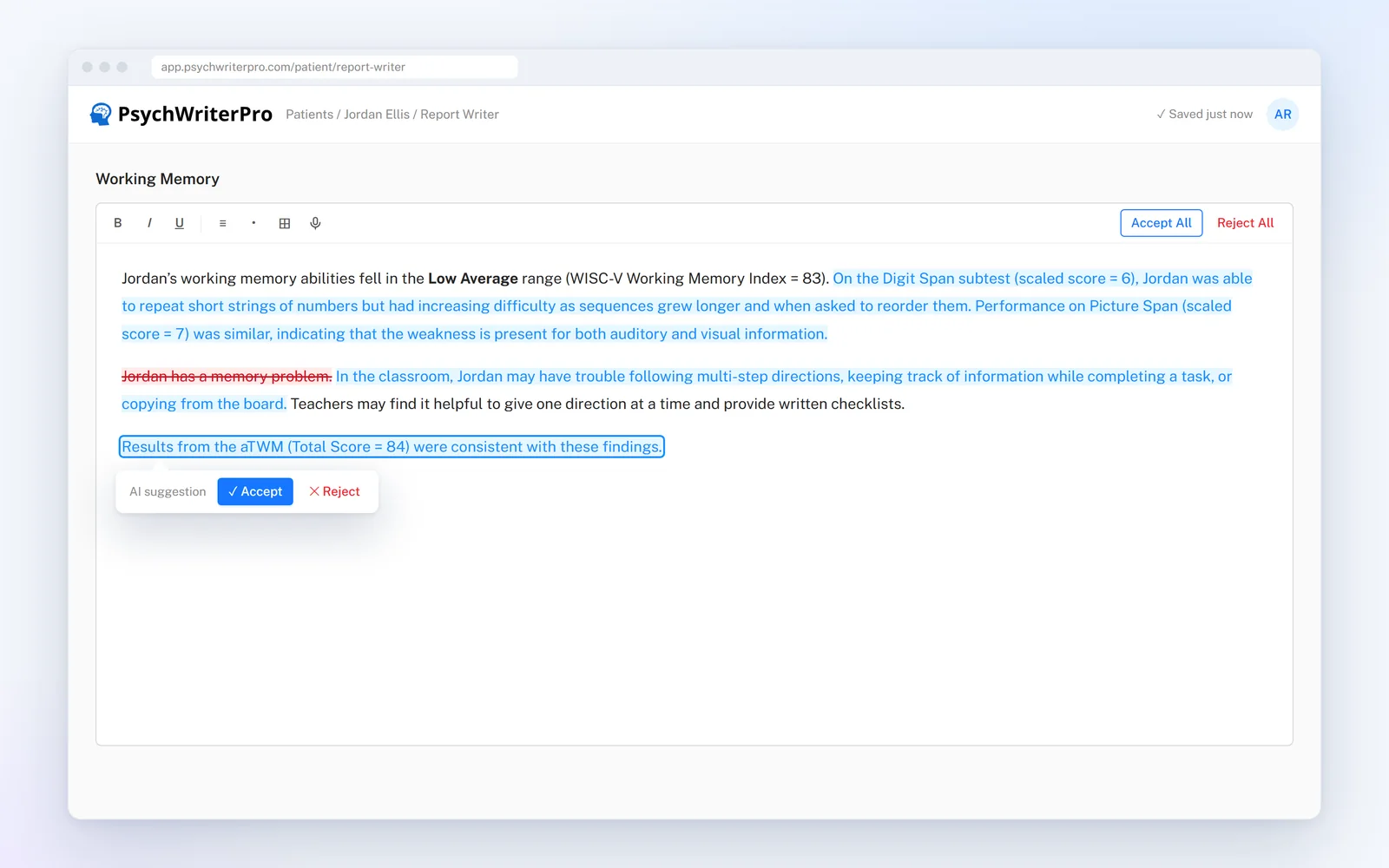
AI drafting from the scores, as tracked changes you accept or reject
One-click export to Word or PDF with your branding
Tests often reported with the NEPSY-II
All of these are supported, and their scores share the same report tables.
Questions
NEPSY-II and PsychWriterPro
Does PsychWriterPro score the NEPSY-II?
No. PsychWriterPro is a report writer, not a scoring service. You enter or import the scores from the publisher's scoring, and PsychWriterPro classifies them, lays out the tables and helps you write the report.
Can I combine the NEPSY-II with other tests in one report?
Yes. Reports are organized by clinical domain, so NEPSY-II subtests appear alongside subtests from the other tests you gave, in the table for what they measure. 297+ tests are supported.
What does a NEPSY-II report look like?
You choose the layout: a full report, tables only, narratives only, or narratives with the tables in an appendix. Reports export to Word or PDF with your letterhead and colors. Sample reports are on the Sample Reports page.
Can I try it first?
Yes. There is a 14-day free trial, and a sample patient is set up for you on day one.
Write your next NEPSY-II report in PsychWriterPro
Try it free for 14 days, with a sample patient set up for you on day one.
NEPSY-II is a trademark of its publisher, Pearson. PsychWriterPro is an independent product and is not affiliated with or endorsed by Pearson.