
PsychWriterPro
Free Trial

WRAML3 report writing, without the busywork

Enter your Wide Range Assessment of Memory and Learning, Third Edition scores once. PsychWriterPro classifies them, builds the score tables and helps you write the interpretation, then exports a finished report to Word or PDF.

Start Free TrialView Sample Reports

14-day free trial · Cancel anytime

Entered for 2,000+ patients by PsychWriterPro customers
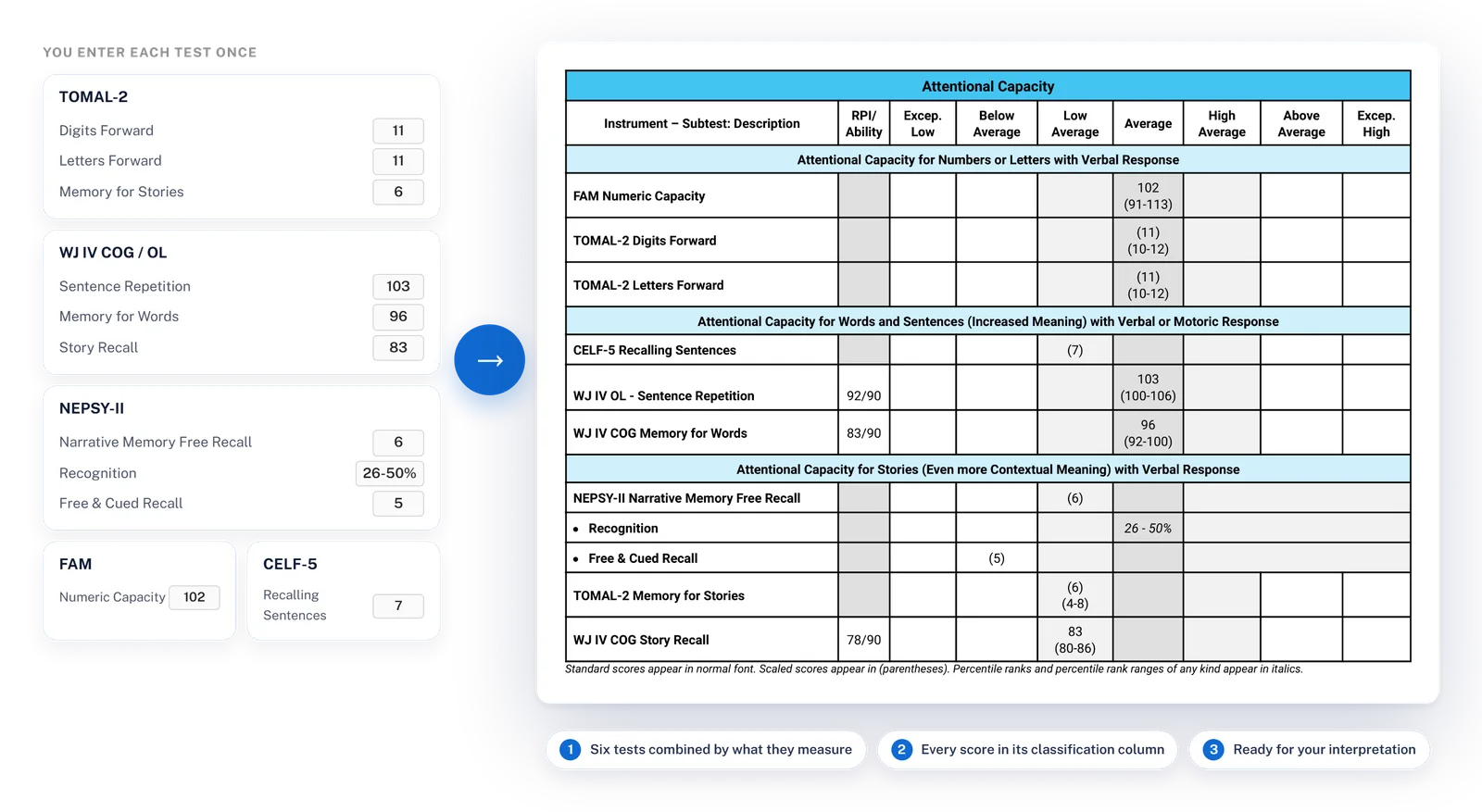
Scores from several tests, including the WRAML3, combined into one classified report table

WRAML3

What PsychWriterPro does with WRAML3 scores

The WRAML3 is an individually administered test battery for children and adults ranging in age from 5 - 90 years, designed to assess learning and memory functions in three separate domains: auditory and verbal memory functions, visual and nonverbal memory.

Every score classified

Each WRAML3 score gets its classification as you enter it, with no manual lookup.

Learning-curve graphs, built in

Learning-curve graphs for the WRAML3 are added to the report automatically.

Placed in the right domain

WRAML3 results land in the report tables for what they measure, alongside the other tests you gave.

Report coverage

Where WRAML3 scores appear in your report

PsychWriterPro places 75 WRAML3 scores into 10 report tables across 4 clinical domains, with confidence intervals where they apply.

WRAML3 scores in report tables
75
report tables
10
clinical domains
4

Cognitive Processes: Learning and Memory

6 tables · 67 scores

Rate of Learning

Measures the ability to learn new information over repeated trials.

  • WRAML3 Verbal Learning Learning a list of words over repeated trials.
  • Trial 1 Number of correctly recalled words on trial 1.
  • Trial 2 Number of correctly recalled words on trial 2.
  • Trial 3 Number of correctly recalled words on trial 3.
  • Trial 4 Number of correctly recalled words on trial 4.
  • Delayed Number of correctly recalled words after delay.
  • Learning Slope An indicator of the rate of learning. The change in the number correct from the first to the last trials.
  • Intrusions Words not on the list that are recalled.
  • Repetitions Words repeated from one trial to another.
  • Primacy Effect Tendency to recall the first few words presented in the list.
  • Recency Effect Tendency to recall the last few words presented in the list.
  • WRAML3 - Design Learning Drawing geometric shapes in proper locations after a brief visual exposure, over repeated trials.
  • Trial 1 Number of correctly recalled shapes on trial 1.
  • Trial 2 Number of correctly recalled shapes on trial 2.
  • Trial 3 Number of correctly recalled shapes on trial 3.
  • Trial 4 Number of correctly recalled shapes on trial 4.
  • Delayed Number of correctly recalled shapes after delay.
  • Learning Slope (Trial 1 - Trial 4) An indicator of the rate of learning. The change in the number correct from the first to the last trials.
  • Upper Left Quadrant Total The amount of information accurately recalled in the upper left quadrant.
  • Upper Right Quadrant Total The amount of information accurately recalled in the upper right quadrant.
  • Lower Left Quadrant Total The amount of information accurately recalled in the lower left quadrant.
  • Lower Right Quadrant Total The amount of information accurately recalled in the lower right quadrant.

Delayed Verbal Memory

Recall and recognition of previously learned verbal details.

  • WRAML3 Verbal Learning Delayed Number of correct words recalled from list after delay.
  • WRAML3 Verbal Learning vs. Verbal Learning Delayed A measure of retention after a 20–30-minute delay.
  • WRAML3 Verbal Learning Delayed vs. Verbal Learning Trial 4 A measure of retention.
  • WRAML3 Story Memory Delayed Number of correct story details recalled after delay.
  • WRAML3 Story Memory Immediate vs. Story Memory Delayed A measure of retention after a 20-30-minute delay.
  • WRAML3 Verbal Learning Recognition Number of words correctly recognized as being on the original learned list of words.
  • Semantic Errors Incorrect recall of words that are similar in meaning (e.g., “car” instead of “truck”).
  • Phonological Errors Incorrect recall of words that sound alike (e.g., “hat” instead of “cat”).
  • WRAML3 Verbal Learning Delayed vs. Verbal Learning Recognition A comparison of delayed (free recall) and recognition memory (cued recall).
  • WRAML3 Story Memory Recognition Number of story details recalled with additional multiple-choice cues.
  • WRAML3 Story Memory Delayed vs. Story Memory Recognition A comparison of delayed (free recall) and recognition memory (cued recall).

Immediate Verbal Memory

Immediate recall of letters, numbers, words, sentences, and stories quickly after exposure.

  • WRAML3 Number Letter Repeating auditorily presented number/letter strings of increasing length.
  • WRAML3 Sentence Memory Memory for sentences of increasing length and complexity.
  • WRAML3 Story Memory Recalling orally presented story details.
  • Story A Recalled details from story A.
  • Story B Recalled details from story B.
  • Story C Recalled details from story C.
  • Story D Recalled details from story D.
  • Story A vs. Story B (ages 5-9) Significant: Y or N
  • Story C vs. Story D (ages 10-90) Significant: Y or N
  • Verbatim Total Exact story details recalled.
  • Gist Total General ideas of story details recalled.

Overall Learning and Memory

  • WRAML3 General Immediate Memory Index
  • WRAML3 Visual Immediate Memory Index
  • WRAML3 Verbal Immediate Memory Index
  • WRAML3 Screener Memory
  • WRAML3 General Delayed Index
  • WRAML3 Visual Delayed Index
  • WRAML3 Verbal Delayed Index
  • WRAML3 General Recognition Index
  • WRAML3 Visual Recognition Index
  • WRAML3 Verbal Recognition Index
  • WRAML3 Working Memory Index

Delayed Visual Memory

Recall and recognition of previously learned visual details.

  • WRAML3 Design Learning Delayed Redrawing geometric shapes in proper locations after a delay.
  • WRAML3 Design Learning vs. Design Learning Delayed A measure of retention after a 20-30-minute delay.
  • WRAML3 Design Learning Delayed vs. Design Learning Trial 4 A measure of retention.
  • WRAML3 Picture Memory Delayed Correctly identifying pictures that appeared in the original stimuli.
  • WRAML3 Picture Memory Immediate vs. Picture Memory Delayed A measure of retention after a 20-30-minute delay.
  • WRAML3 Design Learning Recognition Correctly identifying designs that appeared in the original stimuli.
  • WRAML3 Design Learning Delayed vs. Design Learning Recognition A comparison of delayed (free recall) and recognition memory (cued recall).
  • WRAML3 Picture Memory Recognition Correctly identifying portions of pictures that appeared in the original stimuli.
  • WRAML3 Picture Memory Delayed vs. Picture Memory Recognition A comparison of delayed (free recall) and recognition memory (cued recall).

Immediate Visual Memory

Immediate recall of presented visual details.

  • WRAML3 Finger Windows Using a finger to repeat a visual pattern of increasing length.
  • WRAML3 Picture Memory Detecting changes in specific features or details within four scenes after a brief visual exposure to original scenes.
  • Commission Errors Chosen details in the pictures that did not change.

Attentional Capacity

Measures the ability to learn information with increased content and meaning.

  • WRAML3 Number Letter Repeating auditorily presented number/letter strings of increasing length.
  • WRAML3 Finger Windows Using a finger to repeat a visual pattern of increasing length.
  • WRAML3 Sentence Memory Repeating sentences of increased length and complexity.
  • WRAML3 Story Memory Recalling orally presented story details.

Selective/Focused and Sustained Attention

Measures ability to identify targets (visual or auditory) that are embedded among many distractors or filtering extraneous information and measures the ability to pay attention over prolonged periods of time.

  • WRAML3 Attention/Concentration Index Overall indicator of attentional skills

Working Memory

Measures a student’s ability to actively manipulate information retrieved from memory.

  • WRAML3 Verbal Working Memory Three levels of difficulty, which requires reordering of words to some stimulus property (e.g., word order, size of object, etc.).
  • WRAML3 Visual Working Memory Touching pictures initially touched by examiner following prescribed rules.

Wide Range Assessment of Memory and Learning, Third Edition (WRAML3) - Validity

  • Performance Validity Indicator

Included

Everything you need to write up the WRAML3

  • Scores validated as you enter them

  • Classifications filled in automatically

  • Ready-made score tables, organized by clinical domain

  • A Word-style editor under every table for your interpretation

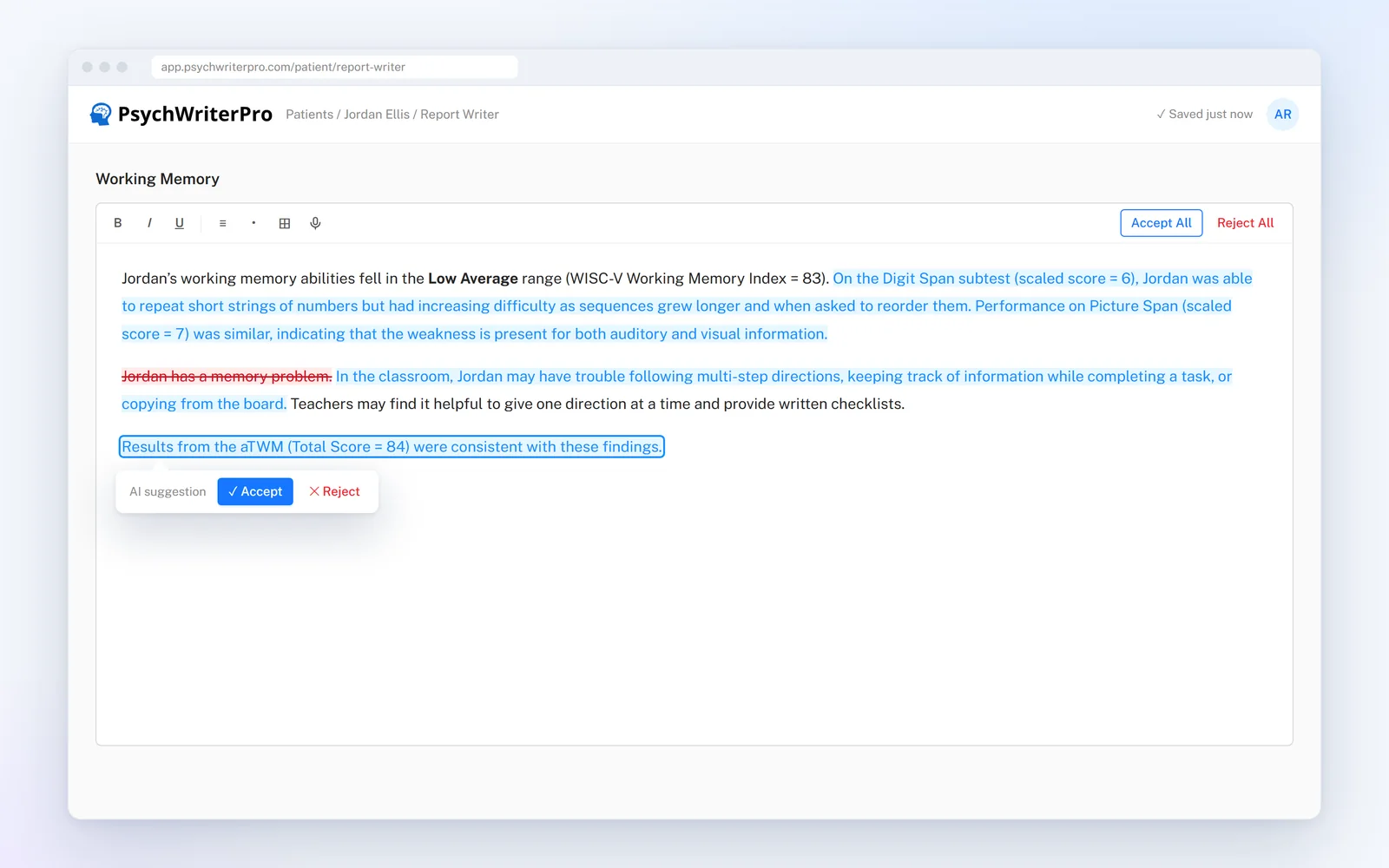
  • AI drafting from the scores, as tracked changes you accept or reject

  • One-click export to Word or PDF with your branding
See all features
An interpretation drafted from the scores, shown as tracked changes to accept or reject

Tests often reported with the WRAML3

All of these are supported, and their scores share the same report tables.

Wechsler Intelligence Scale for Children, Fifth Edition (WISC-V)NEPSY, Second Edition (NEPSY-II)Delis-Kaplan Executive Function System (D-KEFS)Wechsler Adult Intelligence Scale | Fifth Edition (WAIS-5)Kaufman Test of Educational Achievement, Third Edition (KTEA-3)
See all 297 supported tests →

Questions

WRAML3 and PsychWriterPro

Does PsychWriterPro support the WRAML3?

Yes. The Wide Range Assessment of Memory and Learning, Third Edition (WRAML3) is fully supported, with its own score entry screen, automatic classifications and report tables.

No. PsychWriterPro is a report writer, not a scoring service. You enter or import the scores from the publisher's scoring, and PsychWriterPro classifies them, lays out the tables and helps you write the report.

Yes. Reports are organized by clinical domain, so WRAML3 subtests appear alongside subtests from the other tests you gave, in the table for what they measure. 297+ tests are supported.

You choose the layout: a full report, tables only, narratives only, or narratives with the tables in an appendix. Reports export to Word or PDF with your letterhead and colors. Sample reports are on the Sample Reports page.

Yes. There is a 14-day free trial, and a sample patient is set up for you on day one.

Write your next WRAML3 report in PsychWriterPro

Try it free for 14 days, with a sample patient set up for you on day one.

Start Free TrialBook a Demo Call

WRAML3 is a trademark of its publisher, Pearson. PsychWriterPro is an independent product and is not affiliated with or endorsed by Pearson.