
PsychWriterPro
Free Trial

D-KEFS Advanced report writing, without the busywork

Enter your Delis-Kaplan Executive Function System Advanced scores once. PsychWriterPro classifies them, builds the score tables and helps you write the interpretation, then exports a finished report to Word or PDF.

Start Free TrialView Sample Reports

14-day free trial · Cancel anytime

Entered for 900+ patients by PsychWriterPro customers
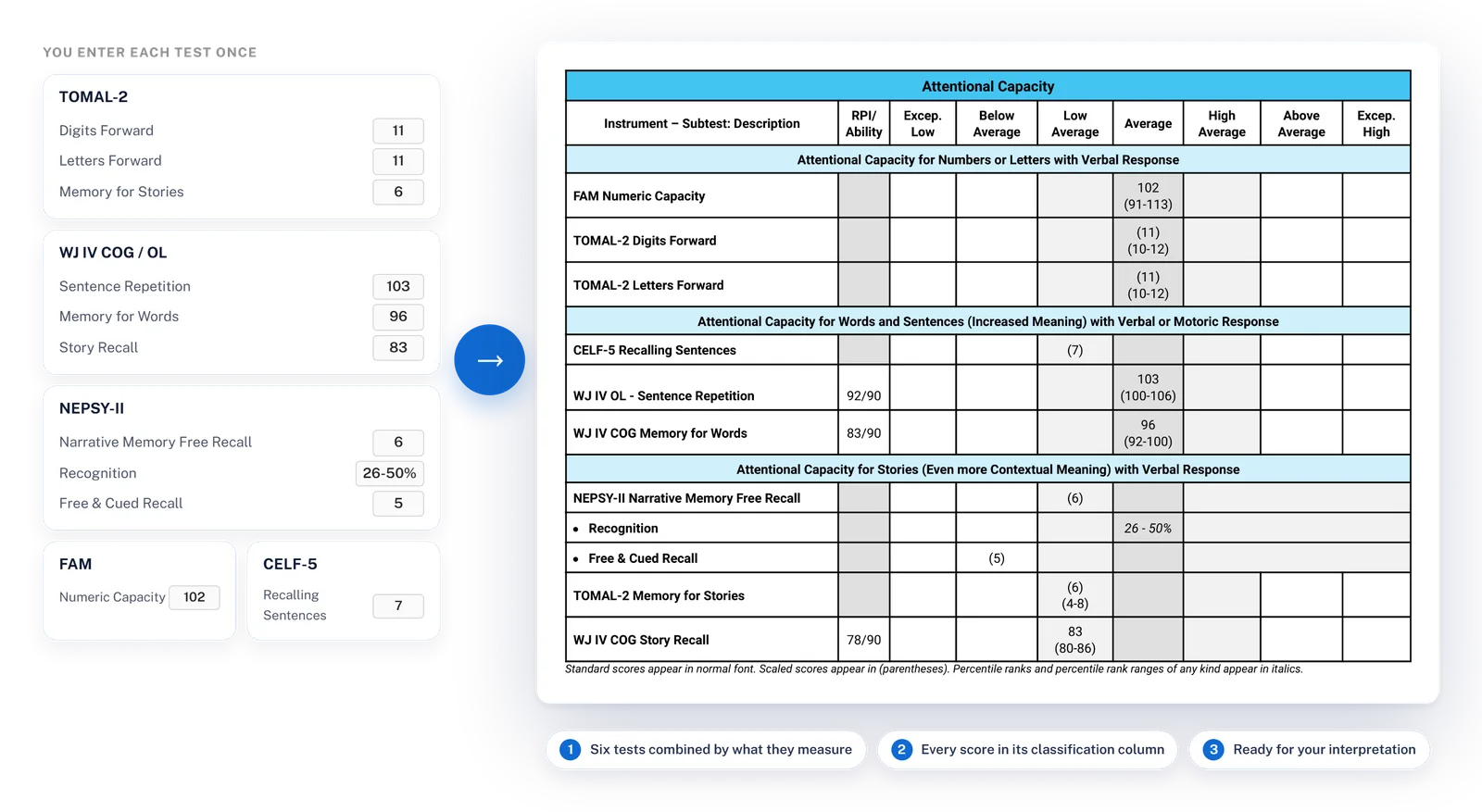
Scores from several tests, including the D-KEFS Advanced, combined into one classified report table

D-KEFS Advanced

What PsychWriterPro does with D-KEFS Advanced scores

Comprehensive assessment of executive functions, in children and adults, ages 8 to 90 years.

Every score classified

Each D-KEFS Advanced score gets its classification as you enter it, with no manual lookup.

Entry that checks your work

The D-KEFS Advanced entry screen adapts to the form and age you pick, and impossible values are caught before they reach a report.

Placed in the right domain

D-KEFS Advanced results land in the report tables for what they measure, alongside the other tests you gave.

Report coverage

Where D-KEFS Advanced scores appear in your report

PsychWriterPro places 173 D-KEFS Advanced scores into 7 report tables across 2 clinical domains, with confidence intervals where they apply.

D-KEFS Advanced scores in report tables
173
report tables
7
clinical domains
2

Cognitive Processes: Executive Functions

4 tables · 149 scores

Qualitative Behaviors for Executive Functions

  • D-KEFS Advanced Color-Word Interference Test
  • D-KEFS Advanced Risk-Reward Decision Test
  • D-KEFS Advanced Social Sorting Test
  • D-KEFS Advanced Tower Test
  • D-KEFS Advanced Trail Making Test
  • D-KEFS Advanced Verbal Fluency Test
  • D-KEFS Advanced Color-Word Interference Test
  • D-KEFS Advanced Risk-Reward Decision Test
  • D-KEFS Advanced Social Sorting Test
  • D-KEFS Advanced Tower Test
  • D-KEFS Advanced Trail Making Test
  • D-KEFS Advanced Verbal Fluency Test
  • D-KEFS Advanced Risk-Reward Decision Test
  • D-KEFS Advanced Trail Making Test Condition 4 Switching-Distraction: Distraction Errors
  • D-KEFS Advanced Color-Word Interference Test
  • D-KEFS Advanced Risk-Reward Decision Test
  • D-KEFS Advanced Trail Making Test
  • D-KEFS Advanced Color-Word Interference Test
  • D-KEFS Advanced Color-Word Interference Test
  • D-KEFS Advanced Risk-Reward Decision Test
  • D-KEFS Advanced Social Sorting Test
  • D-KEFS Advanced Tower Test
  • D-KEFS Advanced Trail Making Test
  • D-KEFS Advanced Verbal Fluency Test
  • D-KEFS Advanced Color-Word Interference Test
  • D-KEFS Advanced Risk-Reward Decision Test
  • D-KEFS Advanced Social Sorting Test
  • D-KEFS Advanced Tower Test
  • D-KEFS Advanced Trail Making Test
  • D-KEFS Advanced Verbal Fluency Test
  • D-KEFS Advanced Color-Word Interference Test
  • D-KEFS Advanced Color-Word Interference Test
  • D-KEFS Advanced Risk-Reward Decision Test
  • D-KEFS Advanced Social Sorting Test
  • D-KEFS Advanced Tower Test
  • D-KEFS Advanced Trail Making Test
  • D-KEFS Advanced Tower Test
  • D-KEFS Advanced Color-Word Interference Test
  • D-KEFS Advanced Risk-Reward Decision Test
  • D-KEFS Advanced Tower Test
  • D-KEFS Advanced Trail Making Test
  • D-KEFS Advance Social Sorting Test Trials to Complete First Category
  • D-KEFS Advanced Color-Word Interference Test Condition 3 Inhibition Percent Error Ratio
  • D-KEFS Advanced Color-Word Interference Test Condition 4 Inhibition/Switching Percent Error Ratio
  • D-KEFS Advanced Trail Making Test Condition 3 – Number-Letter Switching Percent Error Ratio
  • D-KEFS Advanced Trail Making Test Condition 4 –Switching-Distraction Percent Error Ratio
  • D-KEFS Advanced Trail Making Test Condition 5 –Switching-Working Memory Percent Error Ratio
  • D-KEFS Advanced Verbal Fluency Test Total Repetitions
  • D-KEFS Advanced Tower Test Mean Rule Violations per Item
  • D-KEFS Advanced Trail Making Test
  • D-KEFS Advanced Risk-Reward Decision Test
  • D-KEFS Advanced Tower Test
  • D-KEFS Advanced Color-Word Interference Test
  • D-KEFS Advanced Social Sorting Test
  • D-KEFS Advanced Social Sorting Test
  • D-KEFS Advanced Trail Making Test Number Sequencing: Sequencing Errors
  • D-KEFS Advanced Trail Making Test Letter Sequencing: Sequencing Errors
  • D-KEFS Advanced Trail Making Test Number-Letter Switching: Sequencing Errors
  • D-KEFS Advanced Trail Making Test Switching-Distraction: Sequencing Errors
  • D-KEFS Advanced Trail Making Test Switching-Working Memory: Sequencing Errors
  • D-KEFS Advance Social Sorting Test Failure to Maintain Set
  • D-KEFS Advance Social Sorting Test Total Number of Other Responses
  • D-KEFS Advance Social Sorting Test: Percent Other Responses
  • D-KEFS Advance Social Sorting Test Total Number of Derailment Errors
  • D-KEFS Advance Social Sorting Test Percent Derailment Errors
  • D-KEFS Advanced Trail Making Test Number Sequencing Set-Loss Errors
  • D-KEFS Advanced Trail Making Test Letter Sequencing Set-Loss Errors
  • D-KEFS Advanced Trail Making Test Number-Letter Switching Set-Loss Errors
  • D-KEFS Advanced Trail Making Test Switching-Distraction Set-Loss Errors
  • D-KEFS Advanced Trail Making Test Switching-Working Memory Set-Loss Errors
  • D-KEFS Advanced Verbal Fluency Test Total Set-Loss Errors
  • D-KEFS Advanced Trail Making Test Number Sequencing Discontinue Errors
  • D-KEFS Advanced Trail Making Test Letter Sequencing Discontinue Errors
  • D-KEFS Advanced Trail Making Test Number-Letter Switching Discontinue Errors
  • D-KEFS Advanced Trail Making Test Switching-Distraction Discontinue Errors
  • D-KEFS Advanced Trail Making Test Switching-Working Memory Discontinue Errors
  • D-KEFS Advanced Trail Making Test Switching-Distraction Errors
  • D-KEFS Advanced Tower Test Adjusted Mean Unproductive Responses
  • Total 0-Back Moves The number of times an examinee lifted a chip off a table and returned it to the same table.
  • Total 1-Back Moves The number of times an examinee lifted a chip off a table, placed in on a different table, then returned it to the original table.
  • Total 2-Back Moves The number of times an examinee lifted a chip off a table, placed it on one table, then placed it on a different table, and then returned it it the original table.
  • D-KEFS Advanced Verbal Fluency Test

Cognitive Flexibility (Set Shifting)

Measures ability to stop focusing on one activity and start focusing on another activity.

  • D-KEFS Advanced Color-Word Test Inhibition/Switching Net Correct Responses Number of correct responses minus incorrect responses made with the time limit for the inhibition/switching condition
  • Inhibition/Switching Mean Pure Response Time (Correct and Incorrect) The mean time to make any response (correct or incorrect) on the Inhibition/Switching condition.
  • Inhibition/Switching Standard Deviation of Mean Pure Response Time (Correct and Incorrect) Reflects the consistency in the time it takes an examinee to generate responses.
  • Inhibition/Switching Mean Correct Response Time The mean time to make correct responses on the inhibition/switching condition.
  • Inhibition/Switching Mean Incorrect Response Time The mean time to make incorrect responses on the inhibition/switching condition.
  • D-KEFS Advanced Color-Word Interference Test Multitasking Index Combined performance across the two higher level tasks of verbal inhibition and cognitive shifting.
  • Combined Inhibition and Inhibition/Switching Net Correct Responses First-Half Number of correct responses minus incorrect responses made on the Inhibition and Inhibition/Switching conditions during the first half of each test.
  • Combined Inhibition and Inhibition/Switching Net Correct Responses Second-Half Number of correct responses minus incorrect responses made on the Inhibition and Inhibition/Switching conditions during the second half of each test.
  • D-KEFS Advanced Color-Word Interference Test Combined Identification vs. Inhibition/Switching Net Correct Responses Contrast Score
  • D-KEFS Advanced Color-Word Interference Test Inhibition vs. Inhibition/Switching Net Correct Responses Contrast Score
  • D-KEFS Advanced Verbal Fluency Test Switching Fluency Total Correct/Switching Accuracy Index Number of correct responses generated and the number of accurate switches made on the two switching fluency trials.
  • Switching Fluency Total Correct Total number of correct responses made within the time limit for the two switching fluency trials.
  • Switching Fluency Total Accurate Switches The total number of times the examinee accurately switched from a target letter to a target semantic category or vice versa.
  • D-KEFS Advanced Verbal Fluency Test Combined Letter, Category, and Switching Fluency Total Correct Index The combined number of correct responses across all three conditions of the test.
  • D-KEFS Advanced Verbal Fluency Test Combined Letter and Category Fluency vs. Switching Fluency Total Correct Contrast Score.
  • D-KEFS Advanced Verbal Fluency Test Combined Letter and Category Fluency vs. Switching Fluency Total Correct/Switching Accuracy Index Contrast Score.
  • D-KEFS Advanced Trail Making Test Combined Sequencing Mean Correct (With Errors) Connection Time Index Mean correct (with errors) connection time across the two sequencing conditions.
  • Number Sequencing Mean Correct (With Errors) Connection Time Mean time to make each correct connection including time spent on errors en route to the correct connection.
  • Number Sequencing Standard Deviation of Mean Correct (With Errors) Connection Time Reflects the consistency in the time it takes an examinee to generate responses.
  • Letter Sequencing Mean Correct (With Errors) Connection Time Mean time to make each correct connection including time spent on errors en route to the correct connection.
  • Letter Sequencing Standard Deviation of Mean Correct (With Errors) Connection Time Reflects the consistency in the time it takes an examinee to generate responses.
  • D-KEFS Advanced Trail Making Test Combined Sequencing Total Active Errors (Set-Loss + Sequencing) The number of errors actively made across the two sequencing tasks.
  • D-KEFS Advanced Trail Making Test Combined Switching Mean Correct (With Errors) Connection Time Index Mean correct (with errors) connection time across the two switching conditions.
  • Number-Letter Switching Mean Correct (With Errors) Connection Time Mean time to make each correct connection including time spent on errors en route to the correct connection.
  • Number-Letter Switching Standard Deviation of Mean Correct (With Errors) Connection Time Reflects the consistency in the time it takes an examinee to generate responses.
  • Switching-Distraction Mean Correct (With Errors) Connection Time Mean time to make each correct connection including time spent on errors en route to the correct connection.
  • Switching-Distraction Standard Deviation of Mean Correct (With Errors) Connection Time Reflects the consistency in the time it takes an examinee to generate responses.
  • Switching-Working Memory Mean Correct (With Errors) Connection Time Mean time to make each correct connection including time spent on errors en route to the correct connection.
  • Switching-Working Memory Standard Deviation of Mean Correct (With Errors) Connection Time Reflects the consistency in the time it takes an examinee to generate responses.
  • D-KEFS Advanced Trail Making Test Multitasking Index The speed to make correct connections (with errors) and the active error rate across all three switching conditions.
  • Number-Letter Switching Mean Pure Response Speed (Correct or Error Connection) The average speed to make any connection whether correct or incorrect.
  • Switching-Distraction Mean Pure Response Speed (Correct or Error Connection) The average speed to make any connection whether correct or incorrect.
  • Switching-Working Memory Mean Pure Response Speed (Correct or Error Connection) The average speed to make any connection whether correct or incorrect.
  • D-KEFS Advanced Trail Making Test Combined Sequences vs. Number-Letter Switching Mean Correct (with errors) Connection Time Contrast Score
  • D-KEFS Advanced Trail Making Test Number-Letter Switching vs. Switching-Distraction Mean Correct (with errors) Connection Time Contrast Score
  • D-KEFS Advanced Trail Making Test Number-Letter Switching vs. Switching-Working Memory Mean Correct (with errors) Connection Time Contrast Score

Problem Solving, Fluid Reasoning, and Planning

Measures the ability to solve problems, apply reasoning skills, and use planning strategies.

  • D-KEFS Advanced Tower Test – Global Performance Score Number of correctly solved items within the move and time limits plus the bonus points for completing the items in as few moves as possible.
  • Global Performance Score – Solid Items Completing the solid-chip items in as few moves as possible.
  • Global Performance Score – Striped Items Completing the striped-chip items in as few moves as possible.
  • Global Performance Score Solid vs. Striped Items Contrast Score
  • D-KEFS Advanced Risk-Reward Decision Test Total Net Earnings Total net money earned across all 60 trials.
  • Net Earning Races 1-20 Total money earned across races 1-20.
  • Net Earning Races 21-40 Total money earned across races 21-40.
  • Net Earning Races 41-60 Total money earned across races 41-60.
  • Percent $25 Horse Selections Percent of races for which the $25 horse selection was made (the best overall decision to maximize wins)
  • Percent $50 Horse Selections Percent of races for which the $50 horse selection was made (the best overall decision to minimize loses)
  • Percent $100 Horse Selections Percent of races for which the $100 horse selection was made (the best overall decision to minimize loses)
  • Risky Selection Following a Win Percent of races following a win where the examinee selected a higher value horse or stayed with the $50 or $100 dollar horse.
  • Conservative Selection Following a Loss Percent of races following a loss where the examinee selected a lower value horse or stayed with the $25 horse.
  • D-KEFS Advanced Social Sorting Test – Global Performance Index The overall performance derived from the total categories completed total number of sorts made and percent correct sorts made.
  • Total Number of Perseverative Responses Number of perseverative responses made across the completed sorts.
  • Percent Perseverative Responses Percentage of total completed sorts that were perseverative responses.
  • Total Number of Perseverative Errors Number of perseverative errors made across the completed sorts.
  • Percent Perseverative Errors Percentage of total completed sorts that were perseverative errors.
  • Total Number of Nonperseverative Errors Number of nonperseverative errors made across the completed sorts.
  • Percent Nonperseverative Errors Percentage of total completed sorts that were nonperseverative errors.
  • Total Number of Errors Number of sorts made that were incorrect for any reason.
  • Percent Correct Responses Percentage of total completed sorts that were correct (i.e. matched to the correct category).
  • Total Number of Conceptual Level Responses Number of conceptual level responses made across the completed sorts.
  • Percent Conceptual Level Responses Percentage of total completed sorts that were conceptual level responses.
  • Number of Categories Completed Number of categories for which the examinee made 10 consecutive correct sorts.

Response Inhibition

Measures the ability to learn and demonstrate a new response to a stimulus instead of producing a typical response.

  • D-KEFS Advanced Color-Word Interference Test Inhibition Net Correct Responses Number of correct responses minus incorrect responses made with the time limit for the inhibition condition
  • Inhibition Mean Pure Response Time (Correct and Incorrect) The mean time to make any response (correct or incorrect) on the Inhibition condition.
  • Inhibition Standard Deviation of Mean Pure Response Time (Correct and Incorrect) Reflects the consistency in the time it takes an examinee to generate responses.
  • Inhibition Mean Correct Response Time The mean time to make correct responses on the inhibition condition.
  • Inhibition Mean Incorrect Response Time The mean time to make incorrect responses on the inhibition condition.
  • Combined Identification vs. Inhibition Net Correct Responses Contrast Score

Performance Fluency

Measures the student’s ability to quickly perform simple repetitive tasks.

  • D-KEFS Advanced Color-Word Interference Test Combined Color and Word Identification Net Correct Responses Index The combined performance across the two baseline processing speed tasks.
  • Color Identification Net Correct Responses Number of correct responses minus incorrect responses made within the time limit for color identification.
  • Color Identification Mean Pure Response Time (Correct and Incorrect) Average speed to make any response whether correct or incorrect.
  • Color Identification Standard Deviation of Mean Pure Response Time (Correct and Incorrect) Reflects the consistency in the time it takes an examinee to generate responses.
  • Word Identification Net Correct Responses Number of correct responses minus incorrect responses made within the time limit for word identification.
  • Word Identification Mean Pure Response Time (Correct and Incorrect) Average speed to make any response whether correct or incorrect.
  • Word Identification Standard Deviation of Mean Pure Response Time (Correct and Incorrect) Reflects the consistency in the time it takes an examinee to generate responses.
  • Combined Color and Word Identification Net Correct Responses First-Half Number of correct responses made during the first 30 seconds of each test.
  • Combined Color and Word Identification Net Correct Responses Second-Half Number of correct responses made during the second 30 seconds of each test.
  • D-KEFS Advanced Color and Word Identification Test Combined Identification First-Half vs. Second-Half Net Correct Responses Contrast Score
  • D-KEFS Advanced Color-Word Interference Test - Combined Color and Word Identification Total Errors The error rate across the Color Identification and Word Identification conditions.

Assessing Fluency with Accuracy

Measures the interaction between completion time on a task and accuracy. Some students slow down on tasks to be more accurate. Other students are very fast but make many errors. Ideally, students have average completion times with good accuracy.

  • D-KEFS Advanced Color-Word Interference Test: Combined Inhibition and Inhibition/Switching Mean Pure Response Time (Correct & Incorrect) Index The speed of performance across the inhibition and inhibition/switching conditions.
  • Combined Inhibition and Inhibition/Switching Total Errors The number of incorrect responses made across the inhibition and inhibition/switching conditions.
  • Combined Inhibition and Inhibition/Switching Pure Response Speed-Accuracy Tradeoff Contrast Scaled Score A measure of the speed-accuracy tradeoff.
  • D-KEFS Advanced Tower Test Adjusted Mean Pure Response Time Mean time to make all moves and adjusted for the difficulty level of the items.
  • D-KEFS Advanced Tower Adjusted Mean Unproductive Responses vs. Adjusted Mean Pure Response Time Contrast Score
  • D-KEFS Advanced Tower Adjusted Mean Pure Response Speed-Accuracy Tradeoff Contrast Scaled Score
  • D-KEFS Advanced Trail Making Test: Combined Switching Mean Pure Response Speed-Accuracy Tradeoff Contrast Scaled Score Provides insight into the examinee's speed-accuracy tradeoff.
  • Combined Switching Mean Pure Response Speed (Correct or Error Connections) The speed to make any connection whether correct or incorrect across all three switching conditions.
  • Combined Switching Total Active Errors (Set-Loss + Sequencing) Provides insight into the examinee's speed-accuracy tradeoff.

Retrieval Fluency

Measures the student’s ability to quickly access information from long-term memory.

  • D-KEFS Advanced Verbal Fluency Test Letter Fluency Total Correct The total number of correct responses made within the time limit across the three trials.
  • D-KEFS Advanced Verbal Fluency Test Category Fluency Total Correct The total number of correct responses made within the time limit across the two trials.
  • D-KEFS Advanced Verbal Fluency Test Combined Letter and Category Fluency Total Correct Index Combined performance across the two non-switching conditions.
  • Category Fluency vs. Letter Fluency Total Correct Contrast Score

Included

Everything you need to write up the D-KEFS Advanced

  • Scores validated as you enter them

  • Classifications filled in automatically

  • Ready-made score tables, organized by clinical domain

  • A Word-style editor under every table for your interpretation

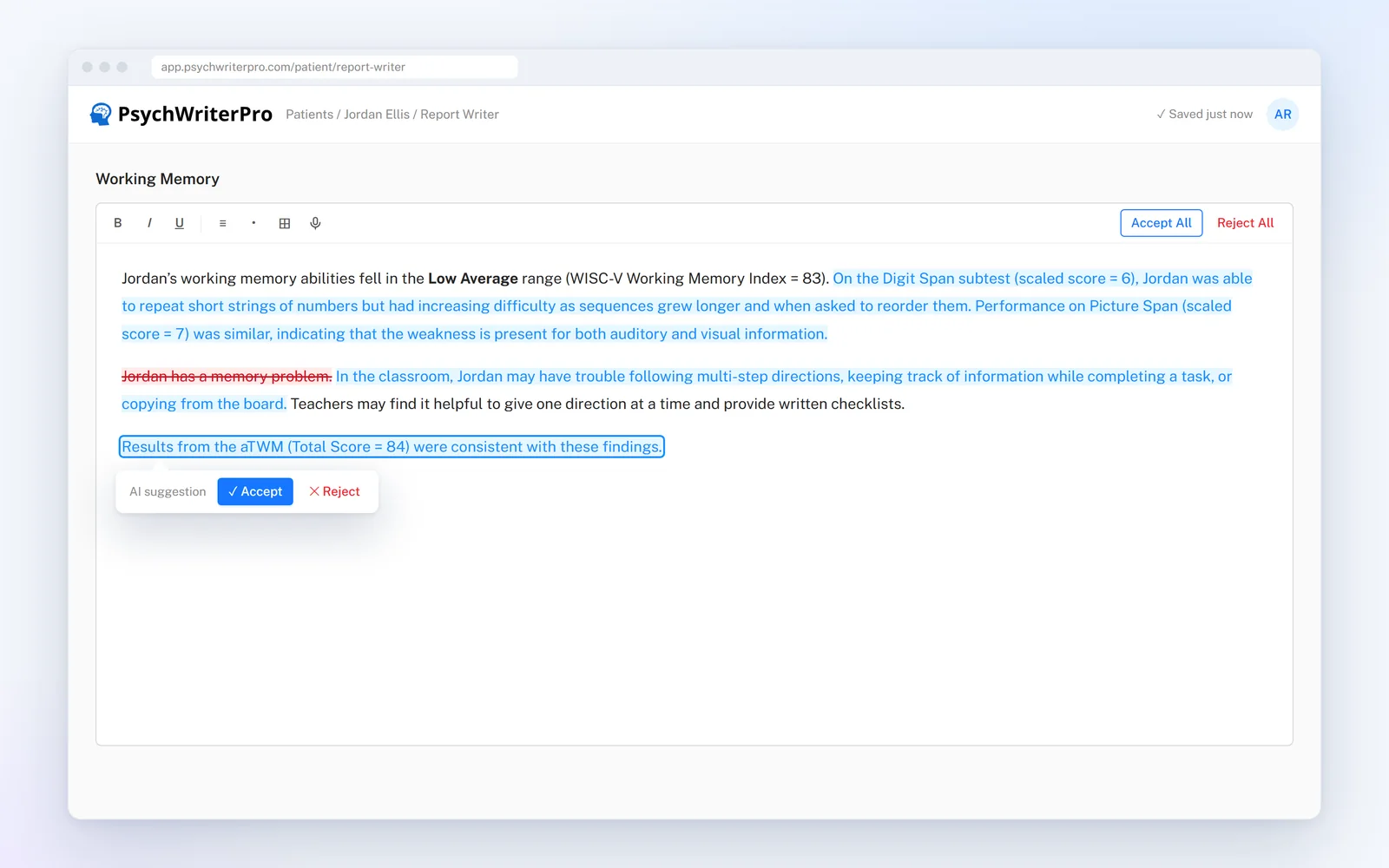
  • AI drafting from the scores, as tracked changes you accept or reject

  • One-click export to Word or PDF with your branding
See all features
An interpretation drafted from the scores, shown as tracked changes to accept or reject

Tests often reported with the D-KEFS Advanced

All of these are supported, and their scores share the same report tables.

Delis-Kaplan Executive Function System (D-KEFS)Behavior Rating Inventory of Executive Function, Second Edition (BRIEF2)Wisconsin Card Sorting Test (WCST)Wechsler Intelligence Scale for Children, Fifth Edition (WISC-V)Wechsler Adult Intelligence Scale | Fifth Edition (WAIS-5)
See all 297 supported tests →

Questions

D-KEFS Advanced and PsychWriterPro

Does PsychWriterPro support the D-KEFS Advanced?

Yes. The Delis-Kaplan Executive Function System Advanced (D-KEFS Advanced) is fully supported, with its own score entry screen, automatic classifications and report tables.

No. PsychWriterPro is a report writer, not a scoring service. You enter or import the scores from the publisher's scoring, and PsychWriterPro classifies them, lays out the tables and helps you write the report.

Yes. Reports are organized by clinical domain, so D-KEFS Advanced subtests appear alongside subtests from the other tests you gave, in the table for what they measure. 297+ tests are supported.

You choose the layout: a full report, tables only, narratives only, or narratives with the tables in an appendix. Reports export to Word or PDF with your letterhead and colors. Sample reports are on the Sample Reports page.

Yes. There is a 14-day free trial, and a sample patient is set up for you on day one.

Write your next D-KEFS Advanced report in PsychWriterPro

Try it free for 14 days, with a sample patient set up for you on day one.

Start Free TrialBook a Demo Call

D-KEFS Advanced is a trademark of its publisher, Pearson. PsychWriterPro is an independent product and is not affiliated with or endorsed by Pearson.