
WIAT-4 report writing, without the busywork
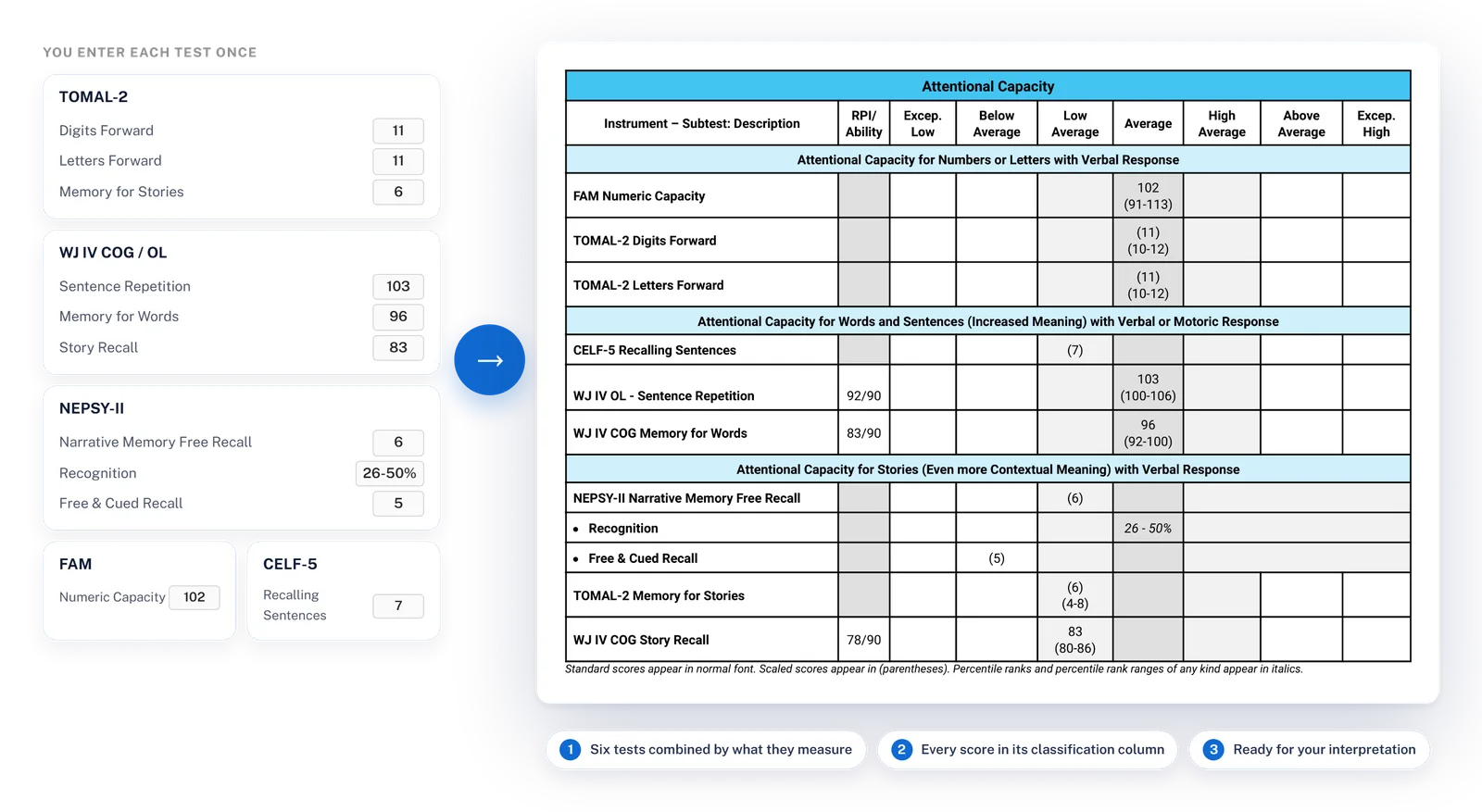
Enter your Wechsler Individual Achievement Test, Fourth Edition scores once. PsychWriterPro classifies them, builds the score tables and helps you write the interpretation, then exports a finished report to Word or PDF.
14-day free trial · Cancel anytime
Entered for 2,000+ patients by PsychWriterPro customers
WIAT-4
What PsychWriterPro does with WIAT-4 scores
Evaluates academic achievement in reading, math, writing, and oral language (expressive and receptive) for ages 4:0 to 50:11 years.
Every score classified
Each WIAT-4 score gets its classification as you enter it, with no manual lookup.
Entry that checks your work
The WIAT-4 entry screen adapts to the form and age you pick, and impossible values are caught before they reach a report.
Placed in the right domain
WIAT-4 results land in the report tables for what they measure, alongside the other tests you gave.
Report coverage
Where WIAT-4 scores appear in your report
PsychWriterPro places 60 WIAT-4 scores into 14 report tables across 9 clinical domains, with confidence intervals where they apply.
- WIAT-4 scores in report tables
- 60
- report tables
- 14
- clinical domains
- 9
Acquired Knowledge: Reading Achievement
2 tables · 17 scores
Reading Achievement
Measures academic skills that require reading.
- WIAT-4 Dyslexia Index (PK-3) Word reading and phonemic proficiency combined.
- WIAT-4 Dyslexia Index (4-12+) Word reading, pseudoword decoding, and orthographic fluency combined.
- WIAT-4 Reading Composite Word reading and reading comprehension combined.
- WIAT-4 Basic Reading Composite Pseudoword decoding, phonemic proficiency, and word reading combined.
- WIAT-4 Decoding Composite Pseudoword decoding and word reading combined.
- WIAT-4 Phonological Processing Composite Pseudoword decoding and phonemic proficiency combined.
- WIAT-4 Pseudoword Decoding Ability to phonologically decode pseudowords.
- WIAT-4 Phonemic Proficiency Measures the development phonological/phonemic skills.
- WIAT-4 Word Reading Measures letter and letter-sound knowledge and single word reading.
- WIAT-4 Orthographic Choice Measures orthographic knowledge. (Q Interactive Only)
- WIAT-4 Reading Comprehension Measures reading comprehension skills at the level of the word, sentence, and passage.
Qualitative Behaviors for Reading
- WIAT-4 - Oral Reading Accuracy
- WIAT-4 - Oral Reading Rate
- Stress and intonation – the reading sounds like natural language with only a few parts read without correct tone and emphasis to match the meaning of the text.
- Pacing and smoothness – single word difficulties are resolved quickly through self-correction.
- Appropriate pausing – the reader uses appropriate pausing to reflect punctuation and structure of the text.
- Phrasing – the reader reads in three-or four-word phrase groups with a few smaller groups possible.
Facilitators/Inhibitors: Speed, Fluency, and Efficiency of Processing
2 tables · 12 scores
Acquired Knowledge Fluency
Measures the degree to which reading, writing, and math is fairly automatic for a student.
- WIAT-4 Reading Fluency Composite Oral reading fluency, orthographic fluency, and decoding fluency combined.
- WIAT-4 Decoding Fluency Measures phonic decoding fluency.
- WIAT-4 Oral Reading Fluency Reading passages aloud and then orally responding to comprehension questions.
- WIAT-4 Orthographic Fluency Measures an examinee’s orthographic lexicon, or sight vocabulary.
- WIAT-4 Writing Fluency Composite A combination of Alphabet Writing Fluency and Sentence Writing Fluency.
- Alphabet Writing Fluency Ability to write the letters of the alphabet quickly.
- Sentence Writing Fluency Measures sentence composition fluency.
- WIAT-4 Math Fluency Composite Solving simple math problems quickly.
- Math Fluency – Addition Solving simple addition problems quickly.
- Math Fluency – Subtraction Solving simple subtraction problems quickly.
- Math Fluency – Multiplication Solving simple multiplication problems quickly.
Retrieval Fluency
Measures the student’s ability to quickly access information from long-term memory.
- WIAT-4 Oral Expression: Oral Word Fluency Ability to quickly name things that fit in a given category.
Acquired Knowledge: Language Abilities
3 tables · 6 scores
Receptive Language (Listening Comprehension)
Measures the ability to understand spoken language.
- WIAT-4 Listening Comprehension Listening to passages and then responding to questions.
- Oral Discourse Comprehension Listening to passages and answering questions about each one.
- Receptive Vocabulary Listening to a word and pointing to a picture that illustrates the word. (NOTE: This is a nonverbal response but is listed here for comparative purposes)
Oral Expression
Measures knowledge of word meanings.
- WIAT-4 Oral Expression A compilation of expressive vocabulary, oral word fluency, and sentence repetition.
- Expressive Vocabulary Naming pictures.
Overall Language Abilities
Composite scores measuring broad language abilities.
- WIAT-4 Oral Language Composite Oral expression and listening comprehension combined.
Acquired Knowledge: Mathematics Achievement
1 table · 3 scores
Mathematics Achievement
Measures academic skills that require a written response.
- WIAT-4 Mathematics Composite Math problem solving and numerical operations combined.
- WIAT-4 Numerical Operations Measures math calculation skills.
- WIAT-4 Math Problem Solving Analyzing and solving practical math problems.
Acquired Knowledge: Overall Achievement
1 table · 1 score
Overall Achievement
Composites of academic achievement.
- WIAT-4 Total Achievement Composite Represents academic ability across several domains.
Cognitive Processes: Auditory/Phonological
1 table · 1 score
Auditory/Phonological Processes
Measures ability to discriminate differences in sounds and speech and to apply basic auditory and phonological processing skills.
- WIAT-4 Phonemic Proficiency Measures the development phonological/phonemic skills.
Cognitive Processes: Learning and Memory
1 table · 1 score
Immediate Verbal Memory
Immediate recall of letters, numbers, words, sentences, and stories quickly after exposure.
- WIAT-4 Oral Expression: Sentence Repetition Repeating sentences of increasing length.
Facilitators/Inhibitors: Allocating and Maintaining Attention
1 table · 1 score
Attentional Capacity
Measures the ability to learn information with increased content and meaning.
- WIAT-4 Oral Expression: Sentence Repetition Repeating sentences of increasing length.
Included
Everything you need to write up the WIAT-4
Scores validated as you enter them
Classifications filled in automatically
Ready-made score tables, organized by clinical domain
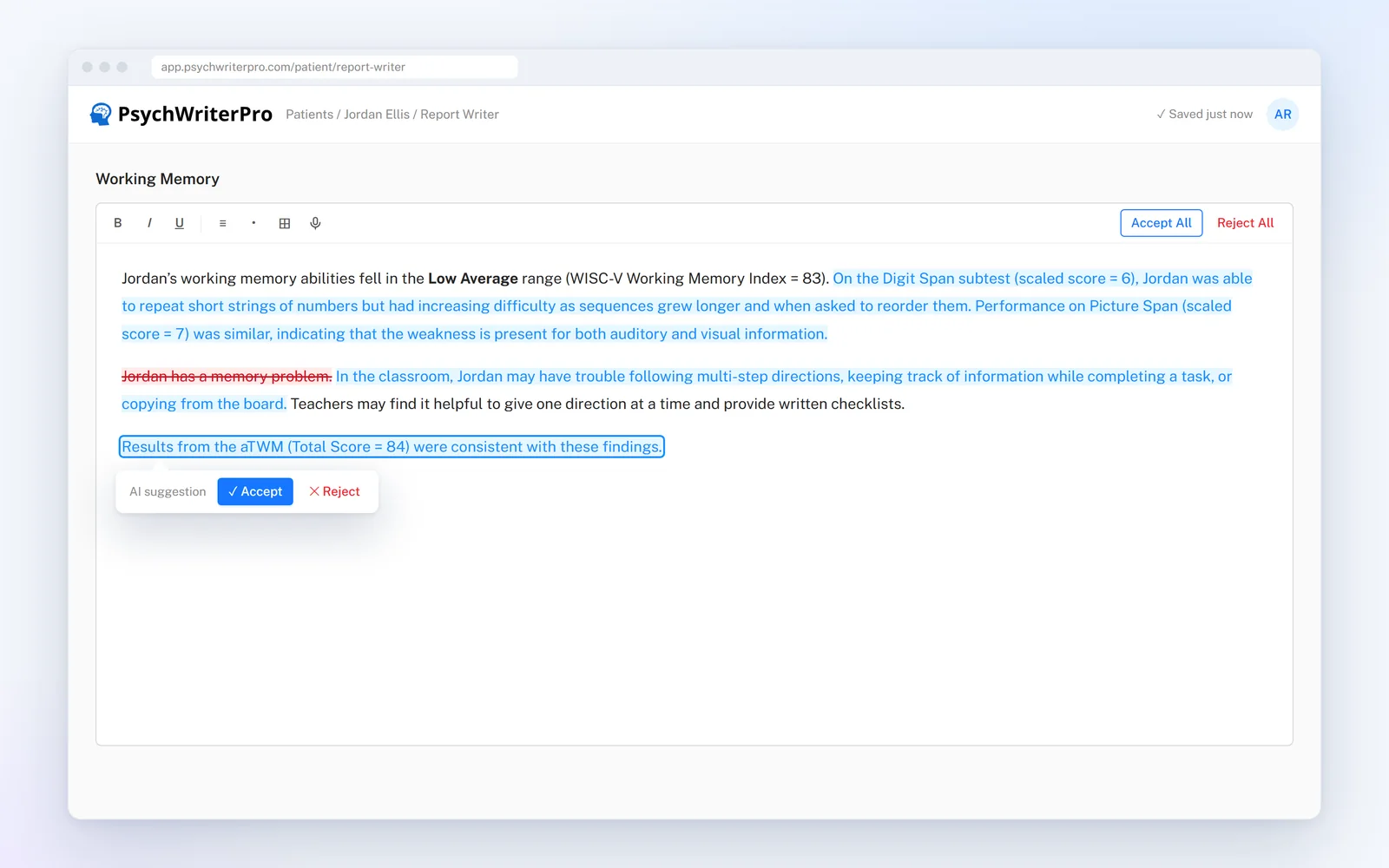
A Word-style editor under every table for your interpretation
AI drafting from the scores, as tracked changes you accept or reject
One-click export to Word or PDF with your branding
Tests often reported with the WIAT-4
All of these are supported, and their scores share the same report tables.
Questions
WIAT-4 and PsychWriterPro
Does PsychWriterPro score the WIAT-4?
No. PsychWriterPro is a report writer, not a scoring service. You enter or import the scores from the publisher's scoring, and PsychWriterPro classifies them, lays out the tables and helps you write the report.
Can I combine the WIAT-4 with other tests in one report?
Yes. Reports are organized by clinical domain, so WIAT-4 subtests appear alongside subtests from the other tests you gave, in the table for what they measure. 297+ tests are supported.
What does a WIAT-4 report look like?
You choose the layout: a full report, tables only, narratives only, or narratives with the tables in an appendix. Reports export to Word or PDF with your letterhead and colors. Sample reports are on the Sample Reports page.
Can I try it first?
Yes. There is a 14-day free trial, and a sample patient is set up for you on day one.
Write your next WIAT-4 report in PsychWriterPro
Try it free for 14 days, with a sample patient set up for you on day one.
WIAT-4 is a trademark of its publisher, Pearson. PsychWriterPro is an independent product and is not affiliated with or endorsed by Pearson.