
FAR report writing, without the busywork
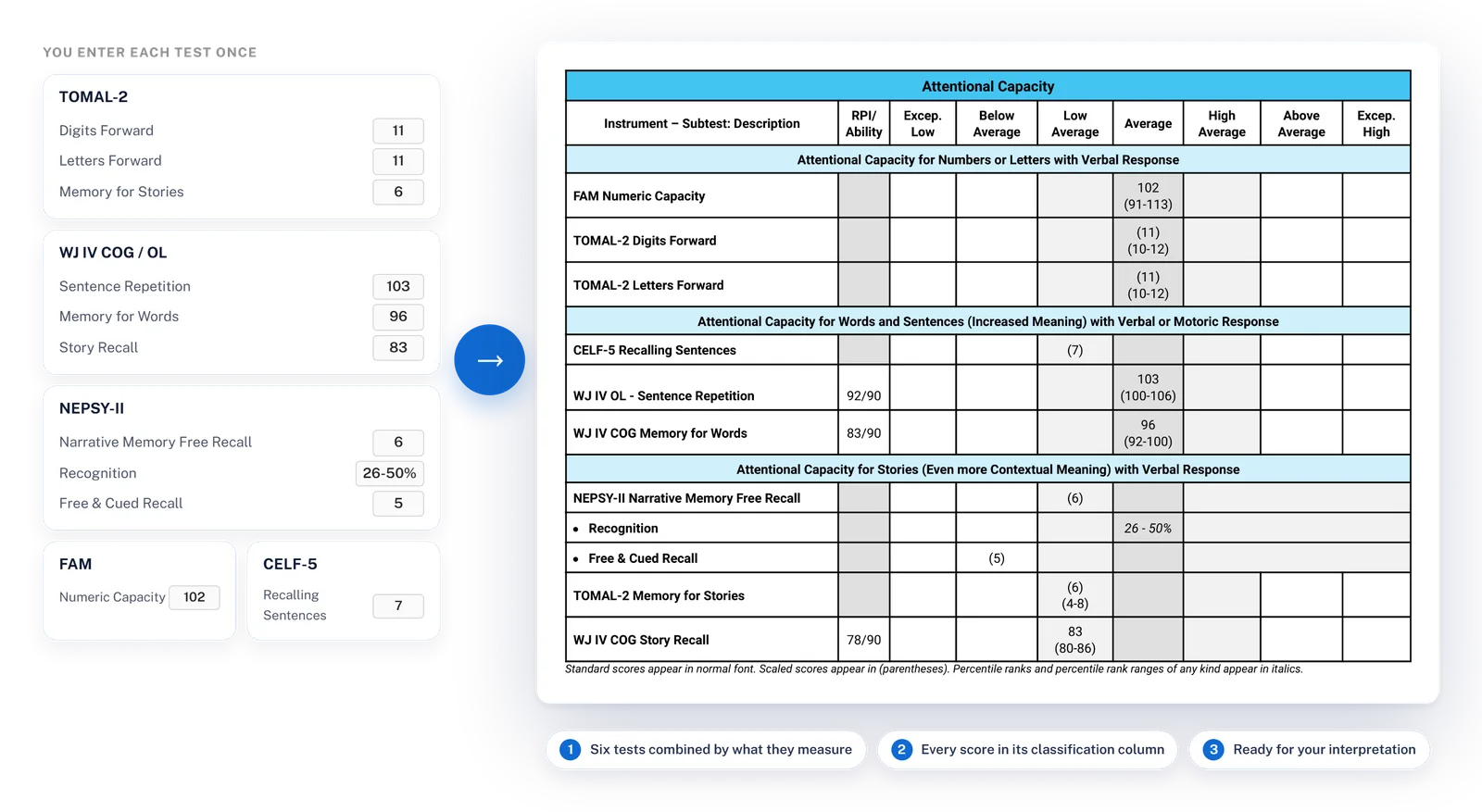
Enter your Feifer Assessment of Reading scores once. PsychWriterPro classifies them, builds the score tables and helps you write the interpretation, then exports a finished report to Word or PDF.
14-day free trial · Cancel anytime
Entered for 600+ patients by PsychWriterPro customers
FAR
What PsychWriterPro does with FAR scores
Designed to measure the underlying cognitive and linguistic processes that support proficient reading in children through adults, ranging in age from 4 - 21 years.
Every score classified
Each FAR score gets its classification as you enter it, with no manual lookup.
Entry that checks your work
The FAR entry screen adapts to the form and age you pick, and impossible values are caught before they reach a report.
Placed in the right domain
FAR results land in the report tables for what they measure, alongside the other tests you gave.
Report coverage
Where FAR scores appear in your report
PsychWriterPro places 22 FAR scores into 9 report tables across 7 clinical domains, with confidence intervals where they apply.
- FAR scores in report tables
- 22
- report tables
- 9
- clinical domains
- 7
Acquired Knowledge: Reading Achievement
1 table · 7 scores
Reading Achievement
Measures academic skills that require reading.
- FAR Phonological Index Significantly low scores are consistent with dysphonetic dyslexia.
- FAR Comprehension Index Significantly low scores are consistent with reading comprehension deficits.
- FAR Total Index Significantly low scores are consistent with overall difficulties with reading.
- FAR Nonsense Word Decoding Ability to decode a series of individual nonsense words.
- FAR Orthographical Processing Ability to recall the letter of group of letters that are in a target word after a short presentation.
- FAR Morphological Processing Ability to choose the morpheme that best completes an incomplete target word.
- FAR Silent Reading Fluency - Comprehension Ability to read a passage and answer questions.
Acquired Knowledge: Acculturation Knowledge
1 table · 2 scores
Semantic Memory
Measures knowledge of basic information retrieved from memory. Semantic memory has three subclassifications within the Integrated SNP/CHC Model: verbal comprehension, general information, and domain-specific knowledge.
- FAR Semantic Concepts Ability to select a word that is similar or opposite in meaning to a target word.
- FAR Print Knowledge Ability to answer pre-literacy questions about a storybook.
Cognitive Processes: Auditory/Phonological
1 table · 2 scores
Auditory/Phonological Processes
Measures ability to discriminate differences in sounds and speech and to apply basic auditory and phonological processing skills.
- FAR Phonemic Awareness A series of four tasks (Rhyming, Blending, Segmenting, & Manipulation) measuring phonemic awareness and processing skills.
- FAR Positioning Sounds Ability to determine the missing sound(s) in an incomplete word.
Cognitive Processes: Learning and Memory
1 table · 1 score
Immediate Verbal Memory
Immediate recall of letters, numbers, words, sentences, and stories quickly after exposure.
- FAR Word Recall Immediate recall of a list of words over two trials.
Cognitive Processes: Visuospatial
1 table · 1 score
Visuospatial Perception
Measures ability to make visual discriminations, locate objects in space, and construct objects.
- FAR Visual Perception Ability to identify letters printed backwards from an array of letters or from an array of words.
Facilitators/Inhibitors: Allocating and Maintaining Attention
1 table · 1 score
Attentional Capacity
Measures the ability to learn information with increased content and meaning.
- FAR Word Recall Immediate recall of a list of words over two trials.
Included
Everything you need to write up the FAR
Scores validated as you enter them
Classifications filled in automatically
Ready-made score tables, organized by clinical domain
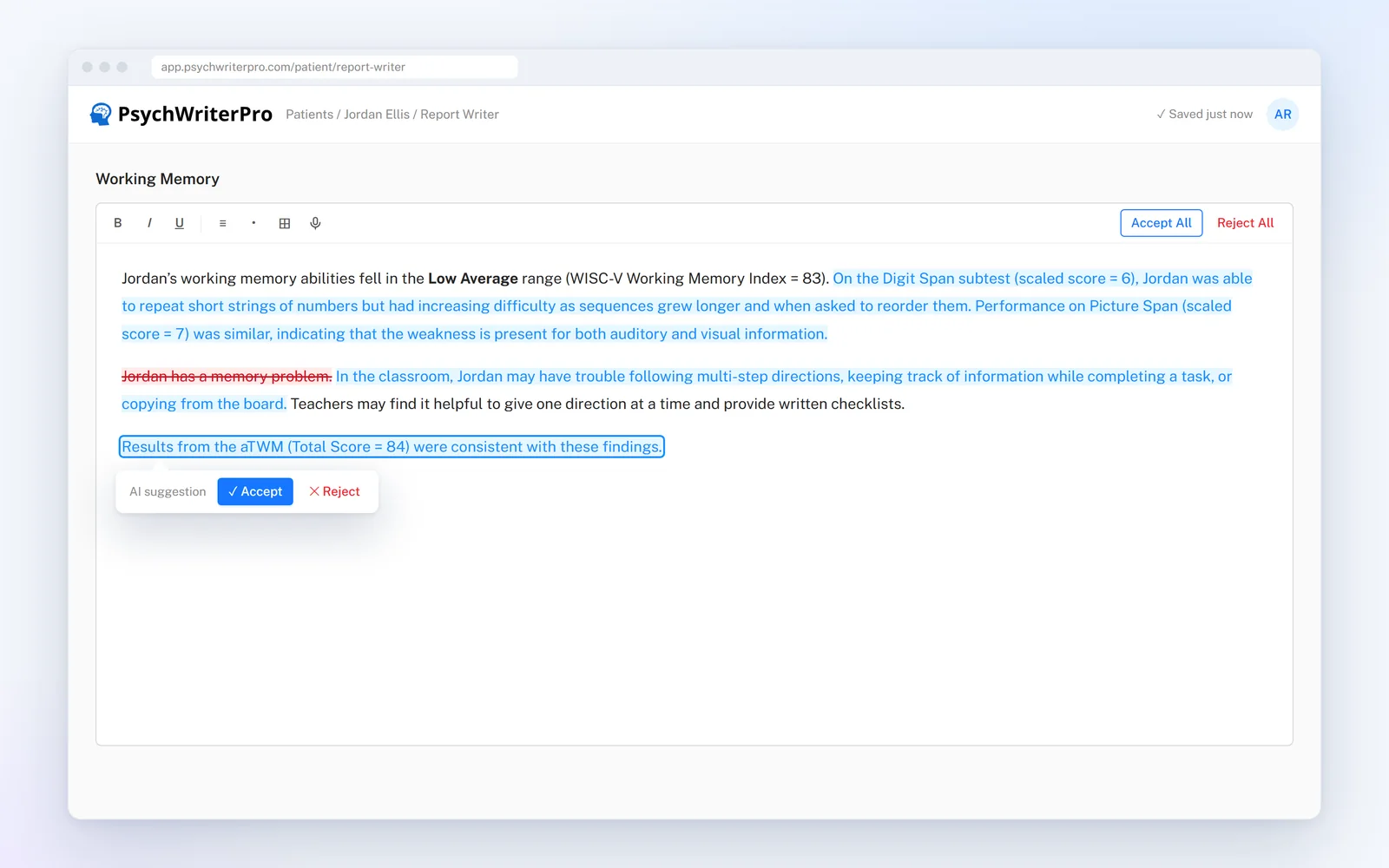
A Word-style editor under every table for your interpretation
AI drafting from the scores, as tracked changes you accept or reject
One-click export to Word or PDF with your branding
Tests often reported with the FAR
All of these are supported, and their scores share the same report tables.
Questions
FAR and PsychWriterPro
Does PsychWriterPro score the FAR?
No. PsychWriterPro is a report writer, not a scoring service. You enter or import the scores from the publisher's scoring, and PsychWriterPro classifies them, lays out the tables and helps you write the report.
Can I combine the FAR with other tests in one report?
Yes. Reports are organized by clinical domain, so FAR subtests appear alongside subtests from the other tests you gave, in the table for what they measure. 297+ tests are supported.
What does a FAR report look like?
You choose the layout: a full report, tables only, narratives only, or narratives with the tables in an appendix. Reports export to Word or PDF with your letterhead and colors. Sample reports are on the Sample Reports page.
Can I try it first?
Yes. There is a 14-day free trial, and a sample patient is set up for you on day one.
Write your next FAR report in PsychWriterPro
Try it free for 14 days, with a sample patient set up for you on day one.
FAR is a trademark of its publisher, PAR. PsychWriterPro is an independent product and is not affiliated with or endorsed by PAR.